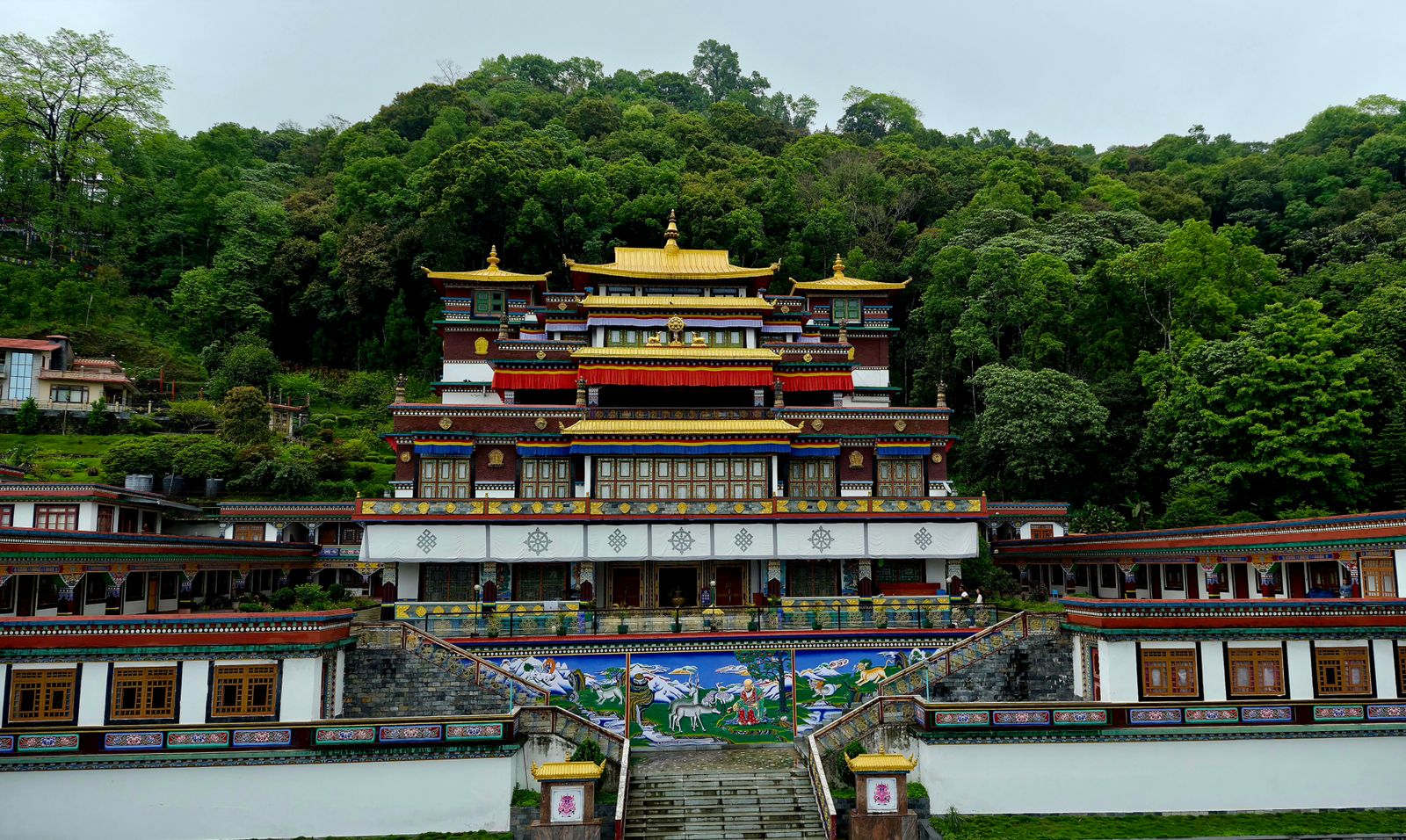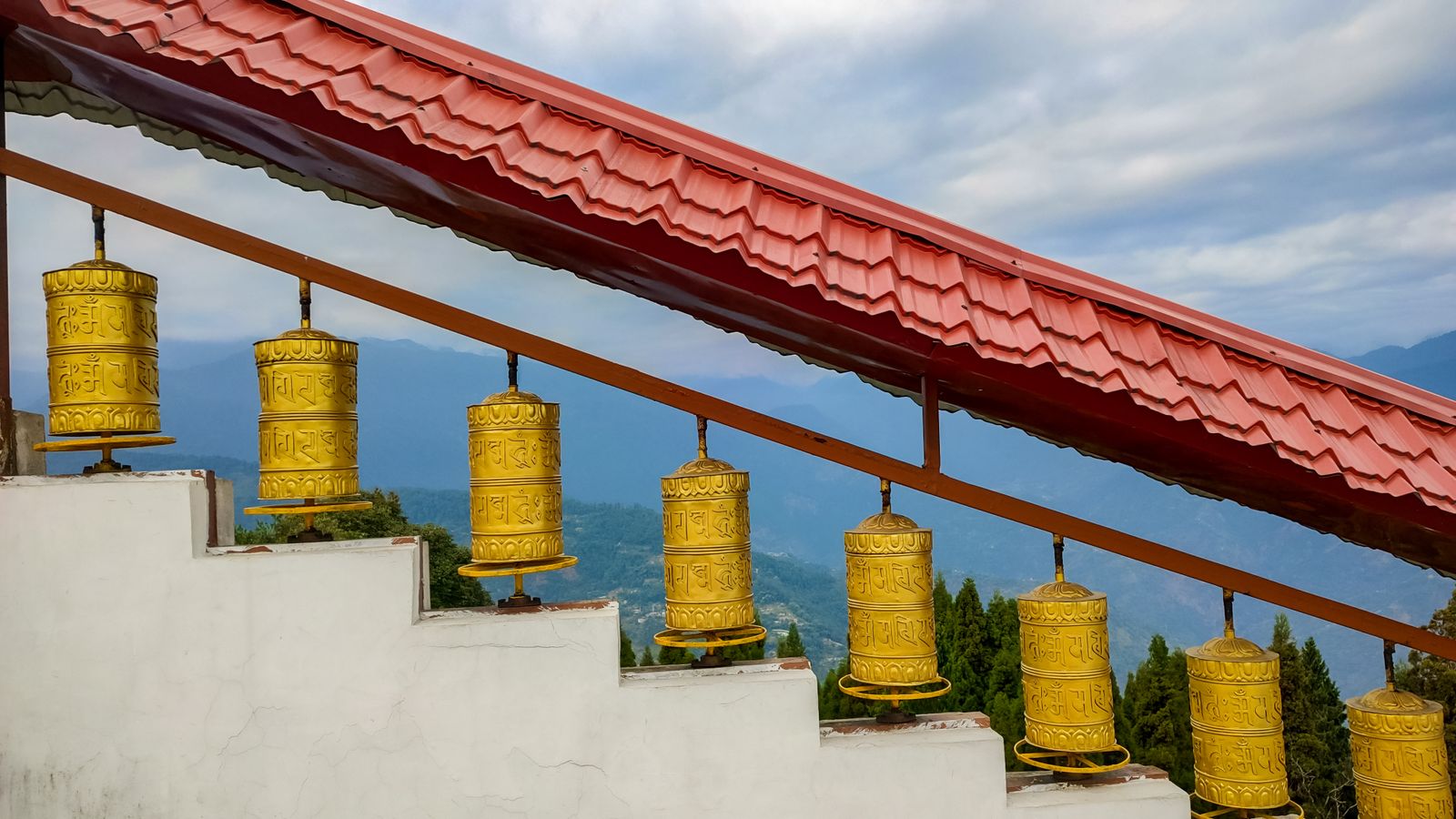
A row of golden prayer wheels on monastery steps above the wooded hills at Gangtok in Sikkim

Signature journey · 8 nights

The First Time: Darjeeling and Sikkim

Gangtok, Pelling, then Darjeeling: the high lake while you are fresh, the mountain close, the airport near.

  • 8nights, private
  • 3bases
  • 4,310 mhighest point
  • ₹1,75,000from, per person, twin share

In short

Is The First Time: Darjeeling and Sikkim right for you?

The First Time is an eight-night private journey for a first visit to Sikkim and Darjeeling, flying in and out of Bagdogra (IXB). You spend three nights in Gangtok with a day at Tsomgo Lake, two in Pelling facing Kanchenjunga, and three in Darjeeling for tea and the steam railway.

Made forfirst-time visitors to the Eastern Himalaya, couples and small groups of friends, families with children over eight and Indian passport holders who want Nathu La.

Not for you ifyou have five days or fewer, or dislike road days of four to five hours, choose Gangtok and the High Lake or The Toy Train Weekend instead.

A first visit to these hills should show you how different three neighbours can be. Gangtok was the capital of a kingdom until 1975, and you sleep in the guest house its Chogyal built in 1932, where a khada is laid round your neck at the door. Pelling is a ridge of monasteries with Kanchenjunga about 45 km from your window, and your room is in the retreat a king of Sikkim built there in 1942. Darjeeling is Nepali, Bengali and British at once, and your hotel began life as Ada Villa in 1841.

Each day is built around one thing worth the journey: a monastery at morning prayer, the shrine of a soldier below Nathu La, the village where Sikkim crowned its first king, a row of tasting cups. The permits are filed while you sleep, the cars change where the rules require, because Sikkim keeps its sightseeing for Sikkim-registered vehicles and the Tsomgo road for permit vehicles alone, and every day carries a plan for cloud, snow and landslides.

Length
8 nights, 9 days
Starts and ends
Bagdogra airport to Bagdogra airport
Best months
October to early December, March to May
Avoid
Mid June to mid September (monsoon)
Pace
Moderate
Longest drive
About 5 hours, 679 km in all
Highest point
Nathu La for Indian passports (other passports top out at Tsomgo, 3,753 m), 4,310 m
Group
Private, 2 to 6 guests

The route

Why Gangtok comes first

Gangtok first, because the altitude rule is simple: two nights at 1,650 m before the lake, and the Nathu La permit needs a day to file. Pelling second, because the road from Gangtok through Ravangla is about 115 km and the road on to Darjeeling only 70. Darjeeling last, because it is the closest of the three to Bagdogra, about three hours away, so a 13:00 flight still leaves you a calm breakfast. Reversed, the final morning becomes four and a half hours on NH10, with its landslide risk.

Sikkim Kanchenjunga 8,586 mJomolhari 7,326 m Bagdogra airport 1 Gangtok · 3 nights 2 Pelling · 2 nights 3 Darjeeling · 3 nights
your bases, in orderby roadborders not drawn

Where the nights go

Read the place guidesGangtok & East SikkimPelling & West SikkimDarjeeling

The shape of the journey

From 126 m to 4,310 m, day by day

You sleep between 1,650 m and 2,130 m. The highest you go is 4,310 m, on day 3 at Nathu La for Indian passports (other passports top out at Tsomgo, 3,753 m), and you come down again to sleep.

Built around

Gangtok, Pelling and Darjeeling at their best

  • Baba Mandir and Nathu La at 4,310 m for Indian passports, after Tsomgo Lake on day three

  • Three heritage houses: the Chogyal's 1932 guest house, a king's 1942 retreat and Ada Villa of 1841

  • Two Kanchenjunga dawns at Pelling and a walk up to Pemayangtse before breakfast

  • Yuksom, where Sikkim's first king was crowned and the trail to Goecha La begins

  • Tiger Hill from the pavilion's top floor, then an hour with the zoo's red pandas

  • First-class steam to Ghum and a tasting at Happy Valley, the tea garden founded in 1854

Day by day

Day by day, Gangtok to Darjeeling

The longest drive is day 3, a round trip from Gangtok, about 5 hours with stops.

  1. Day 1 · Bagdogra airport Gangtok

    Straight up the Teesta while you are fresh

    • 124 km, about 4.5 h
    • High point 1,650 m
    • Sleep at 1,650 m
    • Easy
    The white arch of the Coronation Bridge over the Teesta at Sevoke, its name on the span and forest on the slope behind

    Only ticketed passengers may go into the terminal, so your driver waits just outside the arrivals exit, name board in hand, with cold water, fruit and a rug in the car. The 124 km up NH10 take about four and a half hours, with the Teesta beside you most of the way. At Rangpo, the Sikkim border, foreign guests show their printed e-FRRO permits while Indian guests roll on. At Singtam, where the Rani Khola comes down to meet the Teesta, the car pulls in for tea on the last level ground of the day, because from here the road lifts you about 1,200 m in 30 km. Around 17:30 you turn into The Elgin Nor-Khill, built in 1932 as the Chogyal's guest house. Dinner is early and light in the Shangri-La dining room. Behind the scenes, your ID copies and photographs already sit with our registered Sikkim operator, ready for the Tsomgo permit.

    The momentThe white khada laid round your neck at the Nor-Khill door, with the valley turning blue below the garden.

    InsiderSikkim charges every visitor aged five and over a ₹50 tourist fee, good for 30 days. The Nor-Khill collects it at check-in, and we have already paid it for you.

    If the weather turnsIf slides close NH10, the police open a diversion through Gorubathan. It adds time, so we carry proper snacks and ring the hotel to keep the kitchen open.

    Meals
    Dinner
  2. Day 2 · Gangtok

    Rumtek at prayer, then Gangtok on foot

    • 55 km, about 2 h
    • High point 1,650 m
    • Sleep at 1,650 m
    • Easy
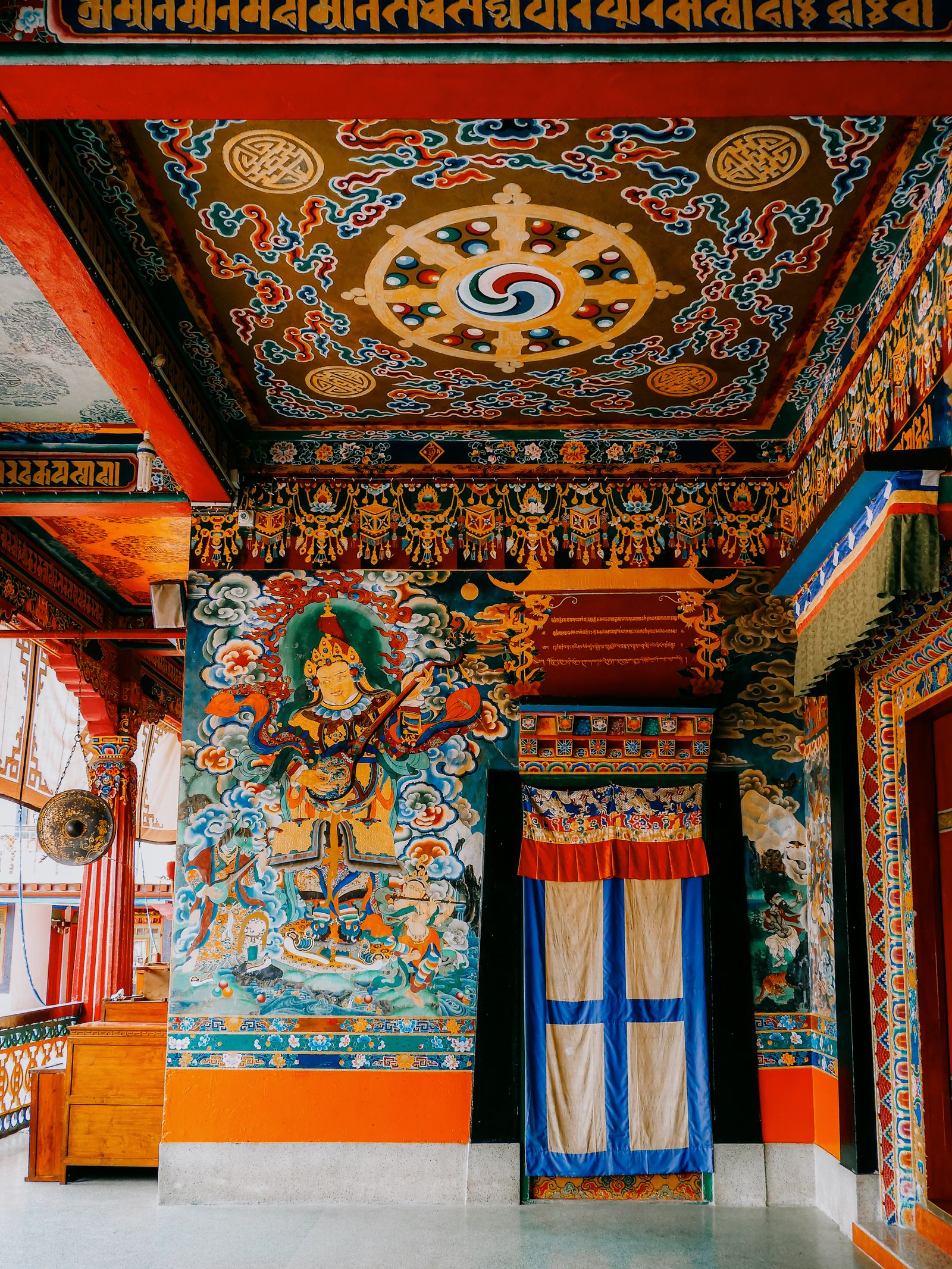
    The painted porch of Rumtek Monastery, a lute playing guardian king on the wall and a mandala on the ceiling above

    At 06:45 the car leaves for Rumtek, about 22 km and an hour across the valley, and you stand at the back of the prayer hall as the horns and drums begin. Afterwards, walk out to the gate and turn round: Gangtok lies along the opposite ridge in the early sun, the whole town in one view, which you never get from inside it. Breakfast back at the hotel by 09:30. At 10:30 the Namgyal Institute of Tibetology opens its museum: a silver Manjushri and a set of five thangkas that tell the story of Sikkim and its Namgyal kings. Walk up to Do-drul Chorten, built in 1945 and 1946, and turn its 108 prayer wheels. Lunch is in a Sikkimese home kitchen: gundruk soup, nettle greens, rice and a first careful bite of dalle chilli. After a rest, the car sets you down at one end of MG Marg at 17:30 and waits at the other. Tonight we confirm tomorrow's permit and the Army's word on Nathu La.

    The momentGangtok spread along the opposite ridge in the morning sun, seen from Rumtek's gate with the chant still going behind you.

    InsiderThe Namgyal Institute allows no shoes and no photographs inside its museum. Leave both in the car and you will spend longer with the silver Manjushri.

    If the weather turnsRumtek and the Institute are both indoors, so rain changes little. If the Institute is shut for a holiday, we take you to Enchey Monastery above the town instead.

    Meals
    Breakfast, Lunch, Dinner
  3. Day 3 · Gangtok

    Tsomgo, Baba Mandir and Nathu La at 4,310 m

    • 120 km, about 5 h
    • High point 4,310 m
    • Sleep at 1,650 m
    • Active
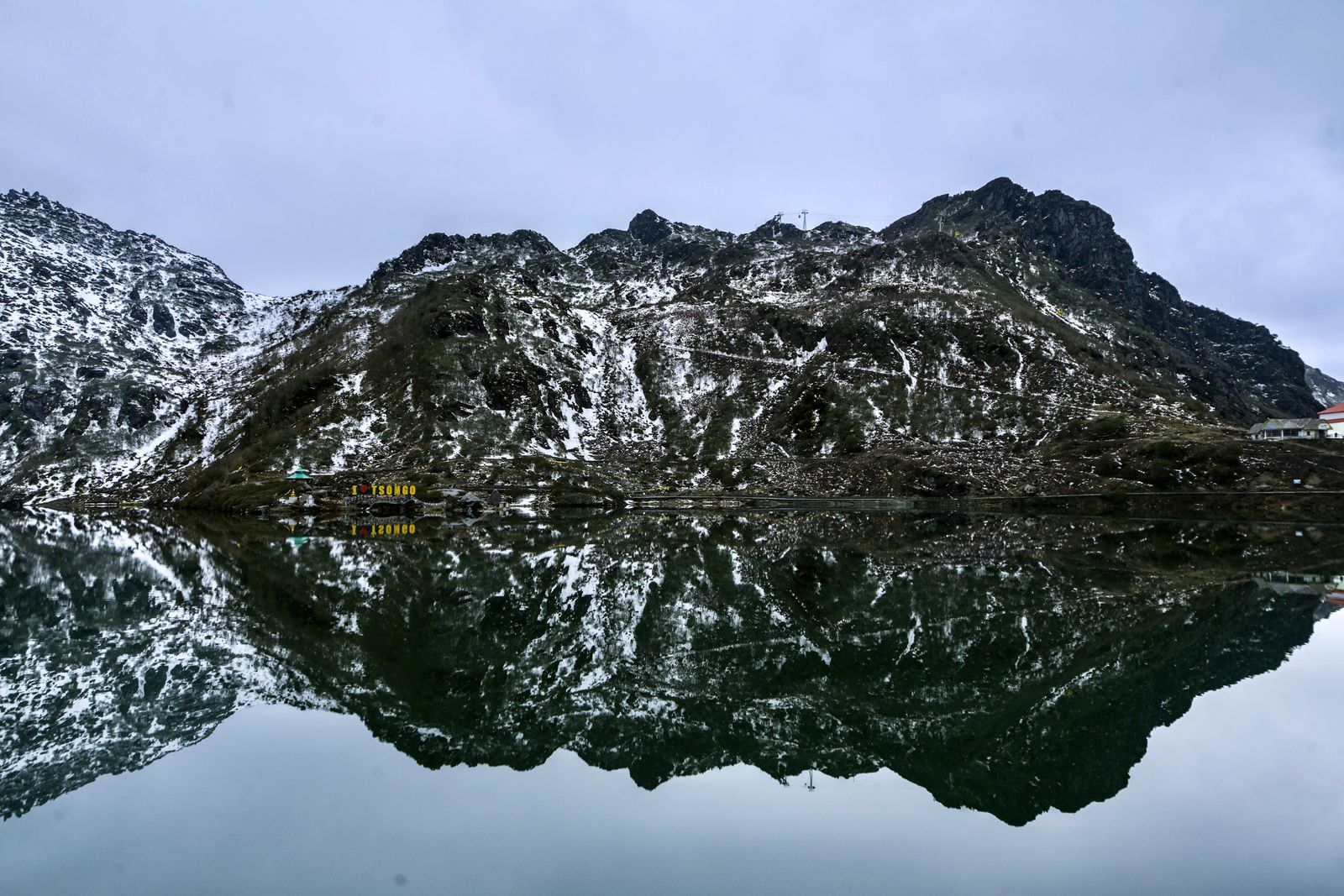
    Prayer flags snapping in the wind beside Tsomgo Lake, hazy morning sun on the water and a lakeside building beyond

    At 06:45 a Sikkim-registered SUV named on your permit replaces our usual car, because only local permit vehicles may use this road. By about 08:45 you stand beside Tsomgo at 3,753 m, after a climb through the rhododendron and silver fir of Kyongnosla; walk slowly and keep the stop short. Indian passport holders go on about 17 km to Nathu La, which is closed to visitors on Mondays and Tuesdays, and arrive near 10:00 as it opens: half an hour at 4,310 m beside the border fence, with Chinese sentries a few paces away. On the way down you stop at Baba Mandir, the shrine to Harbhajan Singh of the 23 Punjab, a sepoy of 22 who died near the pass in 1968 and who, soldiers say, still keeps watch. They also tell how each year on 11 September a jeep carried his belongings down to New Jalpaiguri, with a seat left empty on the train home. Back at Tsomgo by noon for hot noodle soup at the stalls, and at the hotel by 15:00 for a long bath. Foreign and OCI guests keep the morning at the lake and the afternoon for Enchey Monastery and the ropeway.

    The momentPrayer flags cracking in the wind at Nathu La, 4,310 m up, with two armies a few paces apart.

    InsiderNever point a camera towards the Chinese side at Nathu La: the Army stops you at once. Ask the soldier on duty where photographs are allowed.

    If the weather turnsIf the Army shuts Nathu La, it is Tsomgo and Baba Mandir only. If snow shuts the whole road, Enchey and the crafts institute fill the day; the lake has no substitute.

    Meals
    Breakfast, Dinner
  4. Day 4 · Gangtok Pelling

    Across South Sikkim to the Pelling ridge

    • 115 km, about 5 h
    • High point 2,150 m
    • Sleep at 2,100 m
    • Easy
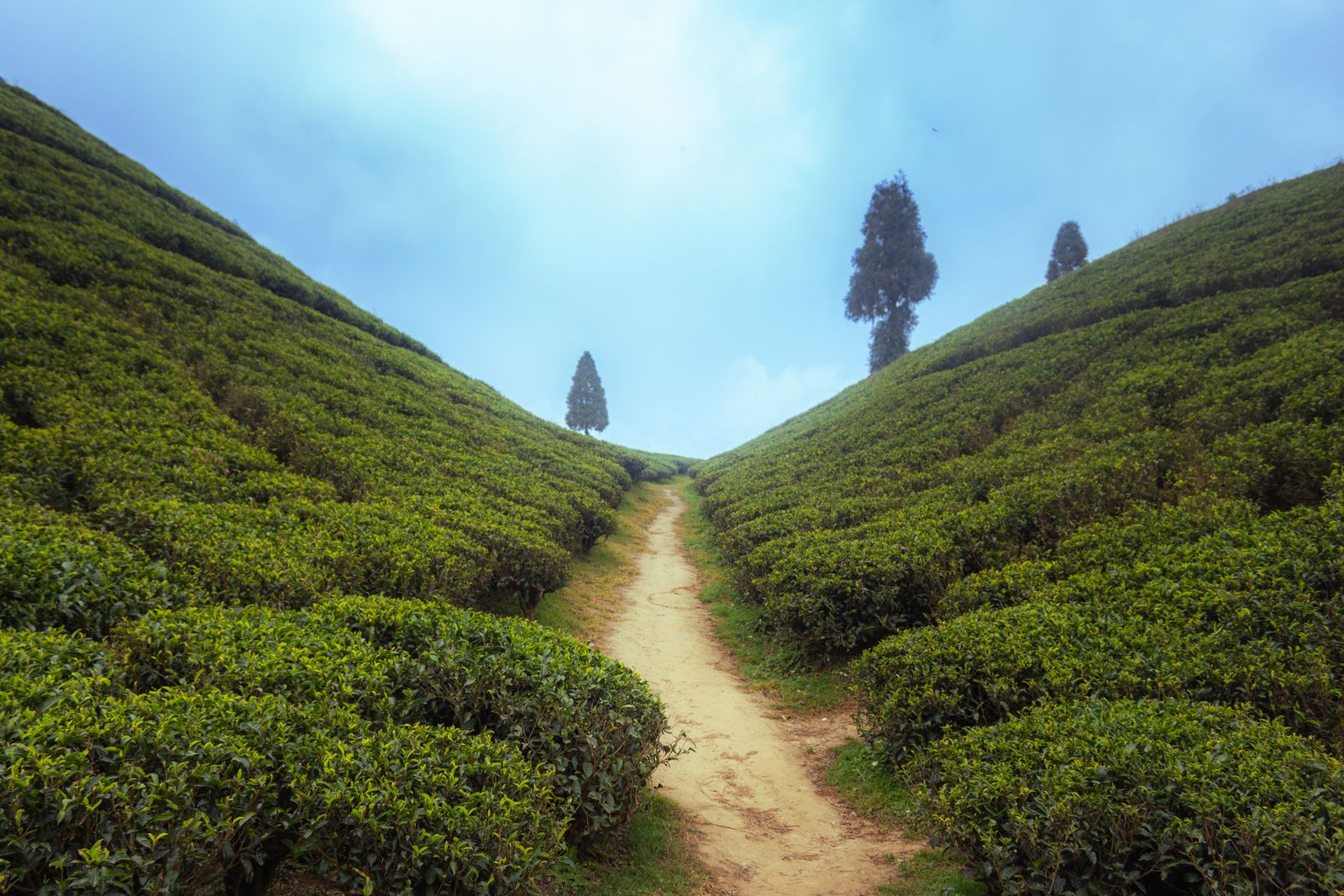
    A dirt path climbing between clipped tea bushes on a Sikkim hillside, a few tall trees on the ridge under a misty sky

    Leave at 08:30, before the town's traffic knots. The road drops to Singtam, crosses the Teesta and climbs through the Temi tea garden, planted in 1969 on the flanks of Tendong. In the first half of November the Temi road runs under flowering Himalayan cherry, pale pink above the dark tea. Ravangla, high on its own ridge, is lunch at 12:00: momos and thukpa at a small kitchen our driver rang from Temi, so the food is on the table as you sit. After lunch the road drops a long way to the Rangeet at Legship, then climbs back through Gyalshing. By 15:15 you are at The Elgin Mount Pandim, the retreat a king of Sikkim built in 1942 on the slope facing Pemayangtse. Tea on the lawn. If the evening is clear, the range turns pink above the monastery roofs around 17:00, and you watch it from a garden chair.

    The momentKanchenjunga turning pink above Pemayangtse's roofs, watched from a garden chair as a cup of tea goes cold.

    InsiderThe hotel is named for Pandim, one of the summits standing beside Kanchenjunga in its view. At sunset, ask your guide to name each peak in turn.

    If the weather turnsIf a slide blocks the Ravangla road, we go round by Melli and Jorethang, about 125 km, and lunch moves to the river at Jorethang.

    Meals
    Breakfast, Lunch, Dinner
  5. Day 5 · Pelling

    Pemayangtse before breakfast, Yuksom by noon

    • 85 km, about 3.5 h
    • High point 2,150 m
    • Sleep at 2,100 m
    • Moderate
    Kanchenjunga and its neighbouring snow peaks under a deep blue sky, seen across forested ridges from Pelling in West Sikkim

    At 05:15 your guide reads the sky and wakes you only if the range is clear; first light reaches the summits near 05:45 in November. At 07:00 walk up to Pemayangtse while its halls are still quiet, the monastery whose head lamas once anointed Sikkim's kings. Breakfast at 08:30, then 15 minutes through the forest to the ruined walls of Rabdentse, the royal capital from 1670 to 1814. At 10:30 the car covers the 34 km to Yuksom, whose name means the meeting place of three learned monks. After a few quiet minutes at Norbugang, the coronation ground of 1642, walk up through the village to where the trail to Dzongri and Goecha La leaves it; the Himalayan Mountaineering Institute starts its Kanchenjunga treks from here too. Lunch is at a family kitchen in the village. On the way back the car turns off for Khecheopalri, and at about 16:00 you turn the wheels along its roofed jetty. Back at the hotel by 17:30.

    The momentThe trail to Goecha La leaving the top of Yuksom, with Kanchenjunga somewhere beyond the forest ahead.

    InsiderPemayangtse's cham falls on the 28th and 29th days of the twelfth Tibetan month, in February, when monks dance as Mahakala and Guru Drag-dmar. It is the one reason to see this courtyard in winter.

    If the weather turnsCloud at dawn: tomorrow brings a second look at 05:45 before the Darjeeling road. In rain, Pemayangtse and Yuksom still work, and the Khecheopalri jetty is roofed.

    Meals
    Breakfast, Lunch, Dinner
  6. Day 6 · Pelling Darjeeling

    Down to the Rangeet and up to the tea ridge

    • 70 km, about 4 h
    • High point 2,150 m
    • Sleep at 2,130 m
    • Easy
    Prayer flags strung thickly over the path to the Mahakal temple on Observatory Hill in Darjeeling

    One more dawn: open the curtains at 05:45 and the range is either there or not. At 09:00 the car leaves Pelling for the 70 km to Darjeeling, down through Gyalshing and Legship to Jorethang on the Rangeet, 322 m, where you cross into West Bengal and begin a climb of more than 1,700 m through tea to the ridge. By 13:00 you reach Windamere Hotel on Observatory Hill, built as Ada Villa in 1841, for lunch. At 14:30 your guide walks you up the short lane to Mahakal, bells ringing among the prayer flags, where Hindu and Buddhist worship share one hilltop. Then down to Chowrasta: Hawa Ghar, the roofed stage on its east side where the town's performances and political speeches happen, the golden statue of the poet Bhanubhakta, and ponies waiting along the Mall. Behind the scenes, our Darjeeling driver queues for tomorrow's Tiger Hill token this afternoon, and your steam tickets were booked the day the railway opened them.

    The momentYour first evening on Chowrasta: ponies led home along the Mall, and the stage at Hawa Ghar empty under the lamps.

    InsiderWindamere has restoration works under way in 2026 between 10:00 and 18:00. We ask for a room away from them, which is why your Darjeeling afternoons are planned out on the hill.

    If the weather turnsIf the Jorethang road is blocked, we go round by Melli and Peshok, about 1.5 hours longer, and lunch on the way. Foreign guests may be asked to use that road anyway.

    Meals
    Breakfast, Dinner
  7. Day 7 · Darjeeling

    Tiger Hill from the top floor, red pandas by noon

    • 30 km, about 1 h
    • High point 2,590 m
    • Sleep at 2,130 m
    • Moderate
    Kanchenjunga's summit ridges catching the early sun above the haze, seen from Tiger Hill near Darjeeling

    Tiger Hill at first light, if the sky allows: your driver took the token yesterday, and at 03:30 he reads the cloud and calls it off if the ridge has closed in. If it is clear, you leave at 04:15 with blankets and a flask, and around 05:55 in November the first sun reaches Kanchenjunga. Breakfast at 07:30, then sleep. From 11:30 one ticket buys three things on Jawahar Parbat: an hour with the zoo's red pandas, an hour with the Everest gear at the Himalayan Mountaineering Institute, and, after lunch nearby, the Bengal Natural History Museum, founded in 1903 and moved into this same compound in 2018, whose cases of hill birds, butterflies and moths put names to what you will see for the rest of the trip. No photographs inside the museum. Then at 16:30, tea by the Windamere fire, booked ahead.

    The momentGloved hands round a flask cup on the pavilion's top floor as the first gold reaches Kanchenjunga.

    InsiderPavilion seats are priced by floor, ₹20, ₹30 or ₹40, and the top floor sees best. Your guide climbs ahead of you to find two places at the rail.

    If the weather turnsCloud at 03:30: we cancel and you sleep, and the range may still show from Observatory Hill later. The zoo, the institute and the museum all close on Thursdays, so this day never falls on one; if your dates force it, days 7 and 8 swap.

    Meals
    Breakfast, Dinner
  8. Day 8 · Darjeeling

    A tasting room, then steam to Ghum

    • 10 km, about 0.5 h
    • High point 2,258 m
    • Sleep at 2,130 m
    • Easy
    A blue steam engine of the toy train breathing smoke at a foggy Darjeeling station as travellers walk past

    At 09:00, as the gates open, the car drops you at Happy Valley, 3 km north of town at about 2,100 m. An Englishman, David Wilson, planted it in the 1850s as the Wilson Tea Estate; in 1903 it passed to Tarapada Banerjee, who joined it to the Windsor estate next door in 1929, and in 2008 its hand-rolled tea went on sale at Harrods. The factory is counted among the highest in the world: in the plucking months you follow the leaf through it, and in winter the tasting table does the work. At 11:00, or the nearest steam departure, you ride the joy ride to Ghum and back in a first-class coach, and you are in town again by 13:00. The afternoon is yours on Chowrasta, where Oxford Book and Stationery, the oldest shop on the square, is the place to lose an hour among the hill books before the light goes. Dinner by the fire.

    The momentAn hour among the shelves of Oxford Book and Stationery, the oldest shop on Chowrasta, as the lamps come on outside.

    InsiderBuy tea only after tasting it, and read the garden and the flush on the packet. The word Darjeeling on its own tells you very little about what is inside.

    If the weather turnsIf the railway cancels the joy ride, we drive to Batasia and the Ghum station museum and time it to watch a train pass. Rain changes little: the tasting room is indoors.

    Meals
    Breakfast, Dinner
  9. Day 9 · Darjeeling Bagdogra airport

    The last hairpins, down to the plains

    • 70 km, about 3 h
    • High point 2,258 m
    • Easy
    A road winding in hairpins down a hillside of tea gardens in the Darjeeling hills

    Breakfast from 07:00. By then the driver has already asked which road down is running cleanly: Rohini, Pankhabari or NH110 through Tindharia, since slides move from year to year. Bags go into the car at 08:15 while you finish your tea, and you leave at 08:30. You pass Ghum station one last time and drop through Sonada to Kurseong, where the toy train's track runs beside the road and crosses it. Below Kurseong the tea gives way to forest, then to the flat green of the plains around Siliguri. The 70 km take about three hours, which brings you to Bagdogra near 11:30, in good time for flights after 13:00. Your driver finds a trolley, carries the bags to the terminal door and stays until you are inside. Our team keeps the phone on until you message from the other side of security.

    The momentA last look back up the ridge above Kurseong as the tea bushes fall away towards the plains.

    InsiderThe Rohini road is the steepest way down and usually the quickest, so drivers choose it with a flight to catch unless a slide has shut it.

    If the weather turnsIf the 07:00 check finds a slide, we leave 30 to 60 minutes earlier by the open road. Monsoon departures keep a spare night lower down before the flight.

    Tonight
    Homeward
    Meals
    Breakfast

Where you will stay

Where you sleep, three houses

The Elgin Nor-Khill, The Elgin Mount Pandim and Windamere Hotel. Prefer a different house on any night? Say which and we re-price it.

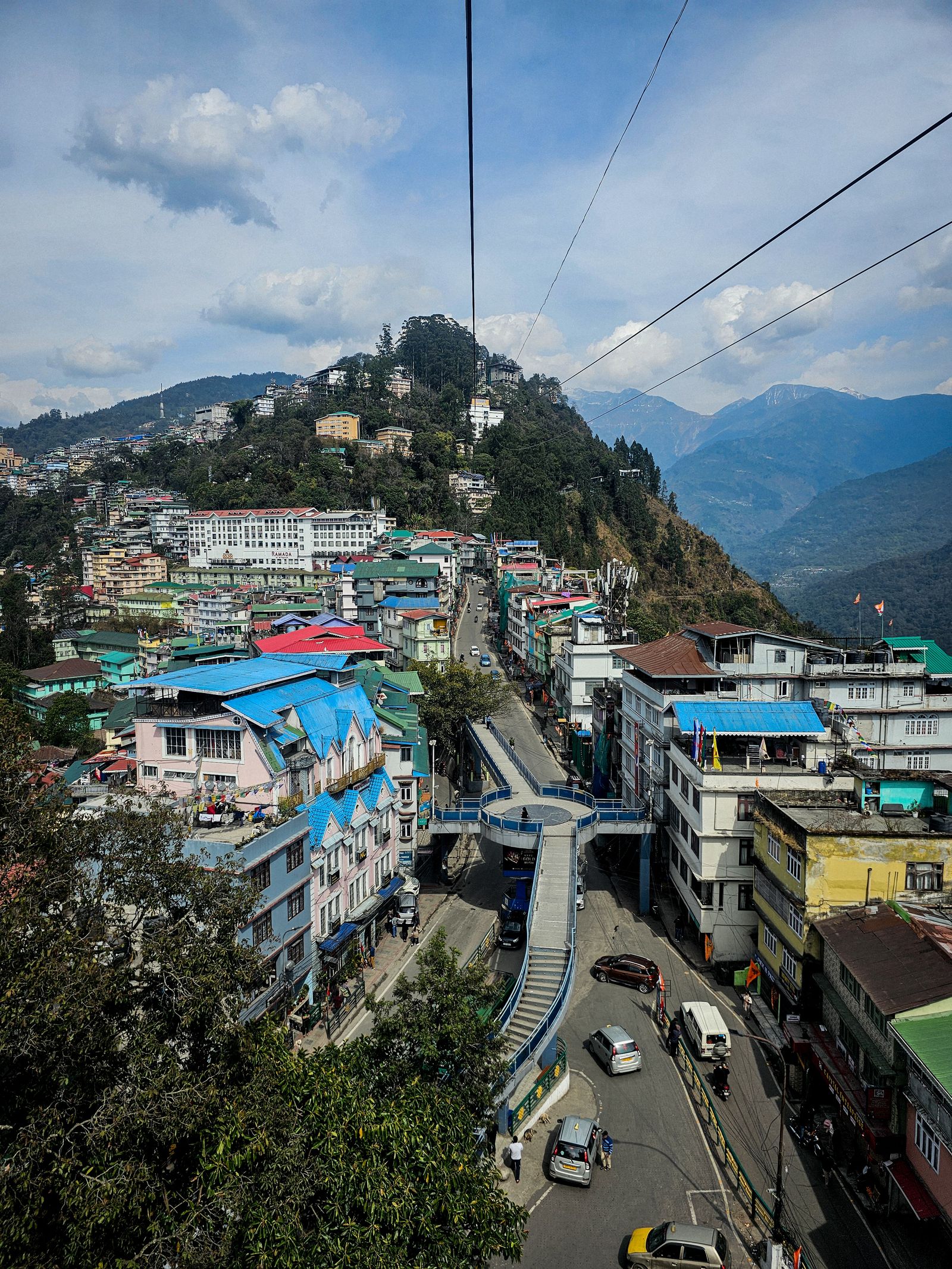
  1. Gangtok seen from above, coloured buildings stacked down the ridge with a footbridge over the road and hills beyond
    Gangtok from above, the town the Nor-Khill sits in the middle of.Ahad Hasan / Pexels
    3 nights

    The Elgin Nor-Khill

    Gangtok

    Built in 1932 as the Chogyal's guest house, with the garden where he painted. Central, so MG Marg and the town monasteries are close.

    Ask for A Deluxe Double on the garden side, or a Deluxe Suite for a sitting room before the early starts

  2. Wicker chairs and a low table on the lawn at The Elgin Mount Pandim in Pelling, with cloud on the wooded ridge behind
    The lawn at Mount Pandim, looking into the cloud on the Pelling ridge.flowcomm, CC BY 2.0, via Wikimedia Commons
    2 nights

    The Elgin Mount Pandim

    Pelling

    A king of Sikkim's 1942 retreat on the slope facing Pemayangtse: you walk to the monastery at 07:00 and back for breakfast.

    Ask for A Deluxe Cottage for the view; a main-building room if steep paths are hard

  3. The Windamere Hotel in Darjeeling seen from its terraced garden, with white painted railings and the hotel signboard
    Windamere from its garden on Observatory Hill.P.K.Niyogi, CC BY-SA 3.0, via Wikimedia Commons
    3 nights

    Windamere Hotel

    Darjeeling

    Built as Ada Villa in 1841 on Observatory Hill: fires, afternoon tea, and Chowrasta a short walk from the door.

    Ask for A Superior room or a Colonial Suite on the side away from the 2026 restoration works, with the fire laid for dusk

Price and what it covers

from₹1,75,000

per person, twin share. How our prices are built

About £1,360 or US$1,820 at the rates of 19 September 2026.

Included

  • Two cars and drivers from the hills: a Sikkim-registered Innova Crysta or similar for days 1 to 6, as Sikkim's sightseeing rules require, then a Darjeeling car with its Tiger Hill token for days 6 to 9, with fuel, tolls and parking
  • A separate Sikkim permit vehicle and driver for the Tsomgo and Nathu La day
  • Eight nights: three at The Elgin Nor-Khill, two at The Elgin Mount Pandim and three at Windamere Hotel, with breakfast and dinner daily
  • Lunch on days 2, 4 and 5: a Sikkimese home kitchen in Gangtok, momos at Ravangla and a family kitchen in Yuksom
  • Licensed local guides in Gangtok, Pelling and Darjeeling on the sightseeing days
  • The Tsomgo permit, and the Nathu La permit for Indian passports, filed through a registered Sikkim operator
  • Sikkim's ₹50 tourist fee, and entry to Rumtek, the Namgyal Institute, Pemayangtse, the Tiger Hill pavilion and the one ticket that covers the zoo, the HMI and the Bengal Natural History Museum
  • First-class seats on the steam joy ride to Ghum, a tasting at Happy Valley and afternoon tea at Windamere
  • For foreign and OCI passports, the Sikkim permit prepared with you through e-FRRO; our Permits and visas guide sets out the rule
  • A name board at the Bagdogra arrivals exit, water and snacks in the car, and 24x7 support from our team in the hills

Not included

  • Flights to and from Bagdogra
  • Travel insurance, which we strongly advise for the high day at Tsomgo and Nathu La
  • Tips for drivers and guides
  • Drinks, laundry, spa treatments and room service
  • The Tsomgo ropeway, yak rides and lunches on days not listed
  • Fireplace or heater charges where a hotel levies them
  • Camera fees at monuments and museums

Make it more Arranged on request, priced in your quote

  • Fly in to GangtokWhen the state helicopter is flying from Bagdogra to Burtuk heliport, we book your seats and send the cases up by road; the state sets the fare, and we quote it for your dates.
  • A steam engine of your ownWe apply to the railway for a steam train of your own to Ghum; it depends on the railway's approval and on which engines are free that week.
  • The climb to DubdiAn hour on foot above Yuksom to Dubdi, founded in 1701 and Sikkim's oldest surviving monastery; we send word so it is open.
  • A hill dinner by our chefSuman Barman, our chef, cooks a last-night dinner of hill dishes for your party at a venue we arrange in Darjeeling.

Before you go

Before you go on this route

Choose another journey ifIf you have five days or fewer, or dislike road days of four to five hours, choose Gangtok and the High Lake or The Toy Train Weekend instead.

  1. Documents for Indian guests: bring the original passport, voter ID or driving licence you sent us for the Tsomgo and Nathu La permits, plus two passport photographs each. Aadhaar is not accepted for these permits, and the Tsomgo permit is issued only to children over five.
  2. Foreign and OCI passports: the Sikkim permit is filed online through e-FRRO about 30 days ahead, Nathu La is closed to you, and Tsomgo needs two or more together. Our Permits and visas guide sets out each rule.
  3. Clothing for October to December: layers for Gangtok's 14 to 20 °C days, a down jacket, hat and gloves for Tsomgo and Tiger Hill, and shoes with grip for monastery steps and wet paths.
  4. Day three reaches 3,753 m at Tsomgo and 4,310 m at Nathu La. Skip alcohol the night before, and ask a doctor first if anyone has a heart or lung condition or is pregnant; our altitude rules are in the Before you travel guide.
  5. Money: UPI and cards work at the hotels and larger shops in Gangtok and Darjeeling. Carry cash for Tsomgo's stalls, monastery donations and village kitchens.
  6. Signal: Jio and Airtel work in the towns. Expect gaps on the Tsomgo road, near Nathu La and in the Rangeet gorge, and download maps and music before you leave.
  7. Road sickness: every drive is hairpins. Take your usual remedy an hour before the Gangtok and Pelling days, sit in front if you need to, and ask the driver for bistarai, slowly.
  8. Tips are never expected on the day and are always your choice; for a figure, see the tipping table in our Before you travel guide.

Questions

Five questions about The First Time: Darjeeling and Sikkim

Ask on WhatsApp
Is The First Time worth doing in late December or February?

Yes, with a different day three. From late December snow can shut the road to Nathu La, and Tsomgo freezes over; the permit car still climbs to the lake when the road is open, and a frozen lake is a sight of its own, but some mornings the road stops short. Pelling and Darjeeling are at their clearest then, with frost at Tiger Hill and Darjeeling nights about 3 to 4 °C. If Nathu La matters most, come between October and early December.

Can a 72-year-old manage day three?

Often, with care. Tsomgo sits at 3,753 m, about two hours' climb from a town at 1,650 m, and Nathu La at 4,310 m is higher still, so ask a doctor before you travel. Many grandparents stop at the lake for under an hour and skip the pass, and the car turns back whenever anyone asks. The Pelling cottages lie down a steep path, so we book main-building rooms, and the 04:15 start for Tiger Hill is optional.

We have nine days: The First Time or Kanchenjunga at First Light?

First Light is built around the mountain, with seven nights split between the Darjeeling, Pelling and Kalimpong ridges and no day above 2,600 m. The First Time swaps Kalimpong for Gangtok, adds the Tsomgo day and Nathu La for Indian passports, and spends more of its time in monasteries and Sikkim's royal history. Choose First Light if altitude worries you or you want slower mornings; choose this if Sikkim's capital and the high lake belong on your first visit.

Why eight nights, and what goes if we have six?

Eight nights gives each place its reason. Three in Gangtok leave a day to adjust before Tsomgo, two in Pelling give two chances at a clear dawn, and three in Darjeeling fit Tiger Hill, a tasting and the steam railway without a rushed morning. With six nights you would drop Pelling or cut Gangtok to two nights, which puts the lake on your second morning. We would rather you dropped Pelling.

What changes on this route for a foreign or OCI passport?

Three things. Nathu La is closed to you, so day three is Tsomgo in the morning and Enchey Monastery and the ropeway in the afternoon. Tsomgo needs two or more foreign guests travelling together. And on day six the police may send foreign passports out of Sikkim by Melli rather than Jorethang, about an hour and a half longer. The Sikkim permit itself is filed online about 30 days ahead, and we prepare it with you.

Sources we checked for this itinerary (47)
  1. Bagdogra to Gangtok about 124 km and 4.5 hours on NH10 via Sevoke, Rangpo and Singtam; Gorubathan diversion when NH10 is closed; Coronation Bridge 1941
  2. Gangtok to Ravangla 66 km (2 hr 30 min) and Ravangla to Pelling 49 km (2 hr 10 min); Ravangla at about 7,000 ft
  3. Road distances recomputed September 2026: Gangtok to Pelling via Temi and Ravangla about 119 km; Pelling to Darjeeling via Jorethang about 67 km; Tsomgo to Nathu La about 17 km; Pelling to Yuksom 34 km; Gangtok to Pelling via Melli and Jorethang about 124 km; Pelling to Darjeeling via Melli about 109 km
  4. The Elgin Nor-Khill built in 1932 by the Chogyal as the royal guest house; Kanchen garden where he painted; acquired 1975
  5. The Elgin Nor-Khill room rates checked for 1 April 2025 to 31 March 2026
  6. The Elgin Nor-Khill: khada and cherry liquor welcome, 25 rooms and suites, Shangri-La dining room
  7. The Elgin Mount Pandim room rates checked for 1 April 2025 to 31 March 2026
  8. The Elgin Mount Pandim built 1942 by the King of Sikkim as a royal retreat, opposite Pemayangtse
  9. Windamere room rates checked for 1 June 2025 to 31 March 2026; afternoon tea by advance booking
  10. Windamere on Observatory Hill, established 1841 as Ada Villa; 2026 restoration works between 10:00 and 18:00
  11. Rumtek open 06:00 to 18:00, about 22 km from Gangtok, golden stupa with the 16th Karmapa's relics
  12. Rumtek: 16th Karmapa arrived 1959 with relics from Tsurphu
  13. Namgyal Institute museum open 10:00 to 16:30, no shoes or photographs; silver Manjushri; five thangkas on the history of Sikkim and the Namgyal dynasty
  14. Do-drul Chorten built 1945 to 1946 with 108 prayer wheels, about 500 m above the Namgyal Institute
  15. Only Sikkim-registered taxis may do Tsomgo, Nathu La and sightseeing within Sikkim
  16. Kyongnosla Alpine Sanctuary around Tsomgo, established 1977: rhododendrons, junipers and silver firs
  17. Tsomgo Lake 3,753 m, about 40 km from Gangtok
  18. Nathu La 2026: open Wednesday, Thursday, Saturday and Sunday, Indian passport holders only, permit filed the evening before, no photographs facing the Chinese side, sentries 15 to 20 m apart
  19. Nathu La usually open Wednesday to Sunday, closed Monday and Tuesday, about 10:00 to 15:00, foreign nationals not allowed, limited daily permits through registered agents
  20. Harbhajan Singh, 23 Punjab Regiment, died near Nathu La in 1968 aged 22; shrine near Nathu La; each 11 September a jeep took his belongings to New Jalpaiguri, with a seat left empty for the journey home
  21. Foreign nationals obtain Sikkim RAP and PAP online through e-FRRO from January 2026
  22. Sikkim ₹50 tourist fee from March 2025, collected at the accommodation, ages five and over, valid 30 days
  23. Temi Tea Garden established 1969 by Palden Thondup Namgyal on slopes of the Tendong range
  24. Pemayangtse planned 1647, pure-lineage monks, head lama anointed the Chogyals; cham on the 28th and 29th days of the 12th Tibetan month (February), lamas dressed as Mahakala and Guru Drag-dmar
  25. Rabdentse capital 1670 to 1814, a short walk from the Pemayangtse gate
  26. Norbugang: Phuntsog Namgyal crowned 1642; stone throne under a pine; footprint attributed to a lama
  27. Dubdi Monastery founded 1701, about an hour's walk above Yuksom
  28. Jorethang on the Rangeet at 322 m
  29. Tiger Hill vehicle tokens issued the day before; pavilion seats ₹20, ₹30 or ₹40 by floor; private and rental cars barred
  30. Ghum Monastery begun 1850, 15-foot Maitreya Buddha
  31. Himalayan Mountaineering Institute founded 4 November 1954, Tenzing Norgay first director of field training
  32. Darjeeling zoo 2026: 08:30 to 16:00, closed Thursday, one ticket covers the zoo, museum and HMI; red panda and snow leopard breeding
  33. Happy Valley Tea Estate founded 1854 by David Wilson as the Wilson Tea Estate; Tarapada Banerjee from 1903, merged with Windsor Tea Estate in 1929; one of the highest tea factories in the world; hand-rolled tea sold at Harrods from 2008; 2,100 m, 3 km north of town; open all week 09:00 to 16:30; new owners in 2022
  34. Singtam at 426 m, about 30 km from Gangtok, at the Teesta and Ranikhola confluence
  35. DHR steam joy ride: fare checked, first class, about 2 hours, 10 minutes at Batasia, 30 minutes at Ghum museum
  36. STDC helicopter Bagdogra to Burtuk, fare checked November 2025, 7 kg luggage free
  37. Sikkim and Darjeeling point-to-point taxi fares checked, 2026
  38. Darjeeling to Jorethang road about 1 hour 45 minutes; noted as not open to foreigners
  39. Only ticketed passengers enter the Bagdogra terminal; the ground-floor exit leads to a covered pick-up area where drivers wait
  40. Sikkim became a state of India in 1975, ending the Chogyal monarchy
  41. Yuksom means the meeting place of three learned monks; starting point of the trek to Goecha La via Dzongri and base camp of the HMI for Kanchenjunga treks
  42. Chowrasta: Oxford Book & Stationery the oldest shop; Hawa Ghar, the roofed stage on the east edge for cultural programmes and speeches; Bhanubhakta statue; pony rides on the Mall
  43. Himalayan cherry (Prunus cerasoides) flowers pinkish white, with a second flowering from September to November
  44. Temi road under flowering cherry in the first half of November (West Sikkim local reviewer, citing Sikkim Tourism's Cherry Tea Festival page)
  45. Bengal Natural History Museum, Darjeeling, established 1903: 697 of the 713 bird species listed for the area, over 600 butterfly and moth specimens
  46. Bengal Natural History Museum founded 1903, moved in May 2018 into the compound that holds the Darjeeling zoo at Jawahar Parbat; open 08:30 to 16:30, closed Thursdays; the ₹110 combined ticket also covers the zoo and the Himalayan Mountaineering Institute; no photography inside
  47. Ravangla's published elevation differs by source (about 7,000 ft on darjeeling-tourism.com, 8,000 ft on Wikipedia), so no figure is printed for it

Checked September 2026. We confirm permits, fees and flights again for your dates.

Plan my journey

The First Time: Darjeeling and Sikkim, shaped around you

At its best October to early December, March to May. Tell us your month and who is travelling, and we reply within 24 hours with this journey priced for your dates.

Length
8 nights
From
₹1,75,000 per person
At its best
October to early December, March to May
Bases
Gangtok, Pelling, Darjeeling
+91 86178 24110 Message a designer Support 24×7, every day of your journey

AboutThe First Time: Darjeeling and Sikkim, 8 nights

With country code if outside India. Either this or email is enough.
Who is coming, the pace you like, the occasion. A sentence is fine.
Add more detail
Their ages help: add them in your note
Permits in Sikkim and fees in Bhutan depend on it
This journey starts at ₹1,75,000 per person. Your band tells us which rooms to price.
Calls from our office, 8am to 9pm IST (GMT+5:30)
Darjeeling, Kalimpong, Gangtok, Pelling, Bhutan, Nepal

No deposit to begin, and nothing is booked until you say yes.