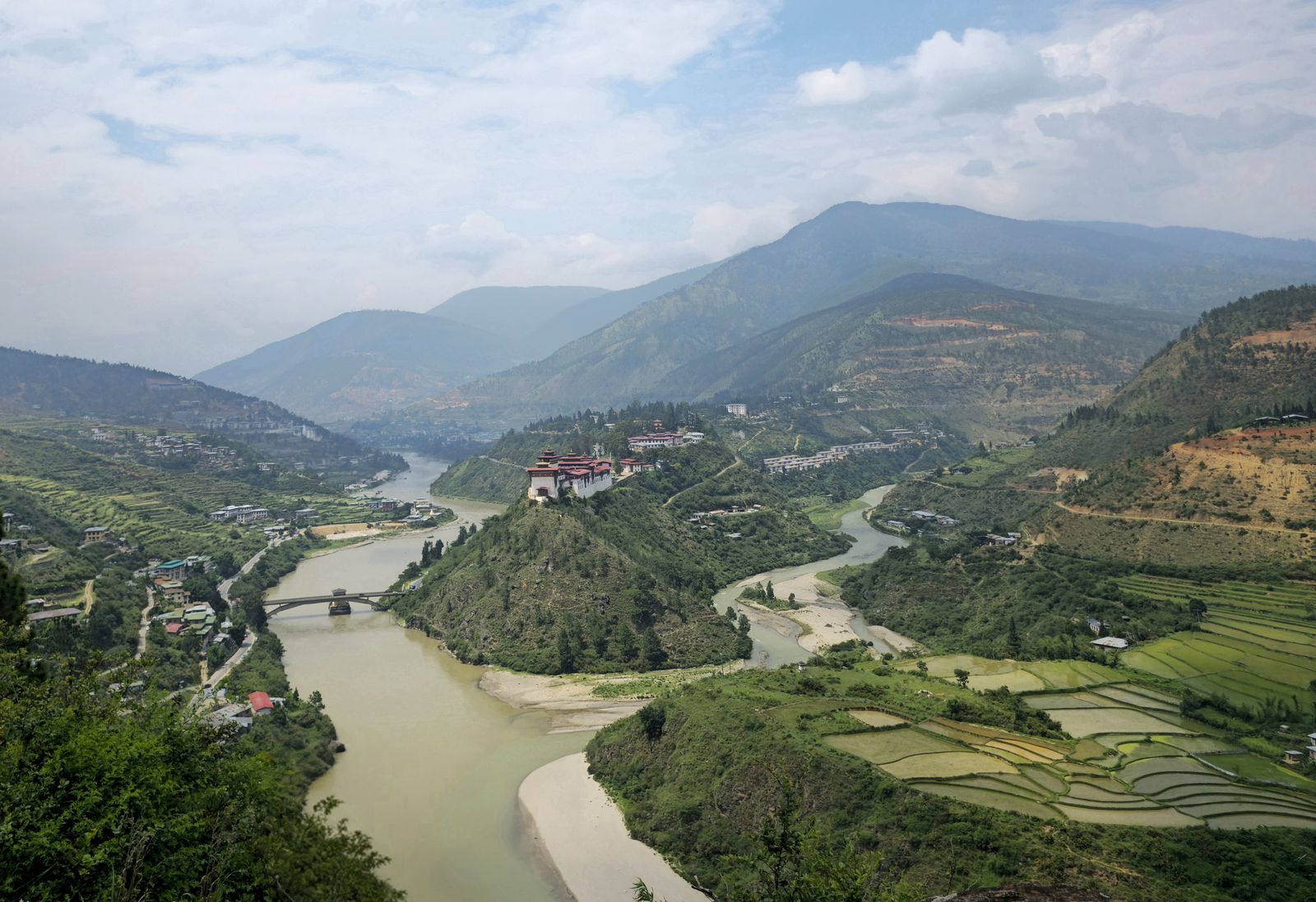
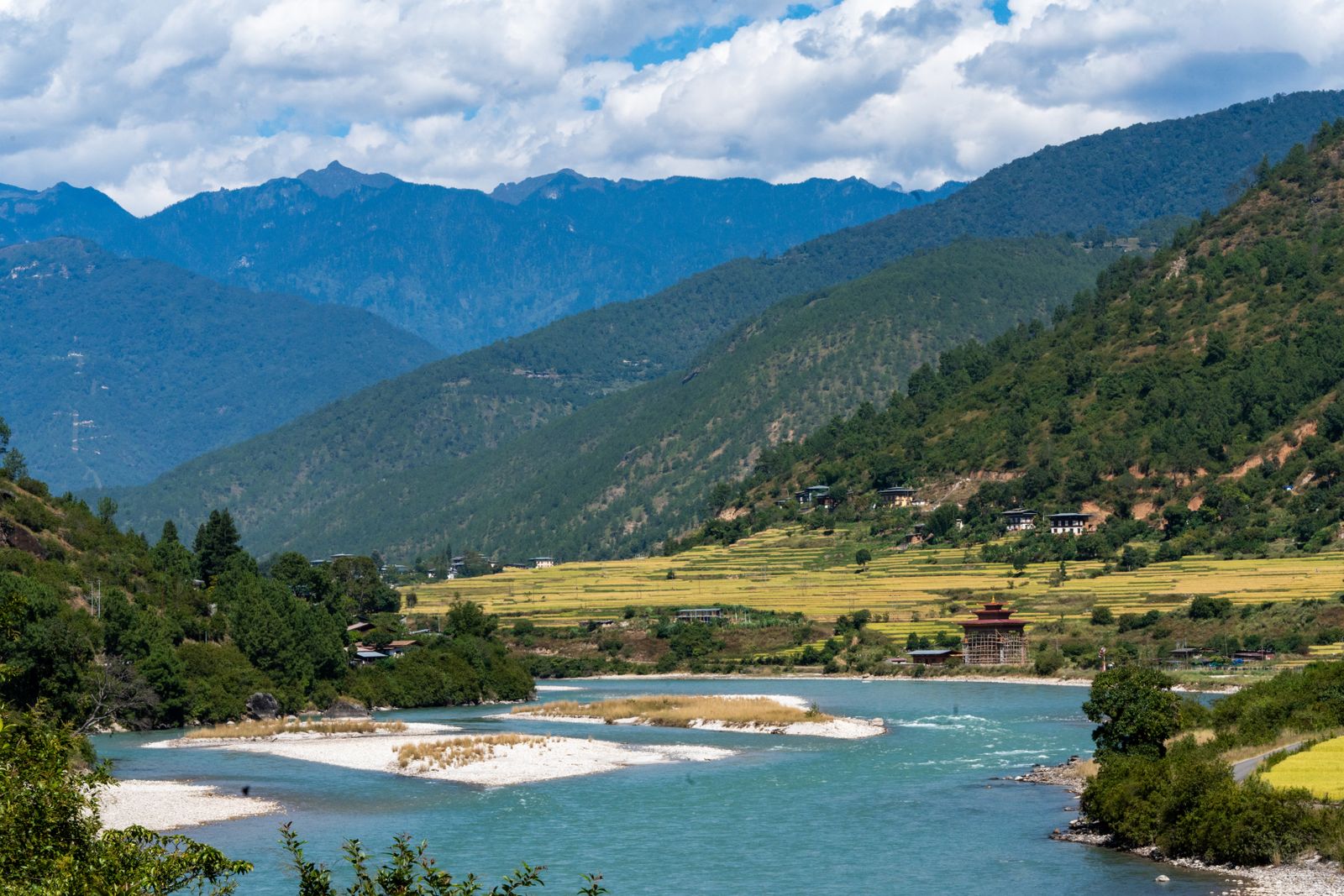
The Paro valley in Bhutan at harvest, rice fields and farmhouses on the floor below Rinpung Dzong and the Ta Dzong on the slope

Signature expedition · 11 nights

Two Kingdoms: Sikkim to Bhutan by Road

Sikkim's royal past, then Bhutan's royal present: eleven nights by road, ending on the cliff at Taktsang.

  • 11nights, private
  • 5bases
  • 4,310 mhighest point
  • ₹5,30,000from, per person, twin share

In short

Is Two Kingdoms: Sikkim to Bhutan by Road right for you?

Two Kingdoms is an eleven-night private journey by road from Bagdogra airport through Sikkim into Bhutan, with a flight home from Paro at the end. Its nights run three in Gangtok, one at the Phuentsholing gate, two in Thimphu, two in Punakha and three in Paro.

Made forcouples and friends who enjoy a long road, families with children over twelve, second-time visitors to the hills and travellers drawn to Buddhist art and ritual.

Not for you ifa seven-hour road day or a 520 m climb sounds like work, choose Bhutan: The Western Valleys, which flies you into Paro and keeps every drive short.

Sikkim and Bhutan were once two Buddhist kingdoms on either side of the same wedge of mountains. Sikkim's crown ended in 1975. Bhutan's still holds court in fortresses raised in the 1600s. The threads between them are close: the 16th Karmapa, who rebuilt Rumtek across the valley from Gangtok, helped consecrate Thimphu's Tashichho Dzong in 1968, and Bhutan's first flag was drawn in 1947 by a princess born into Sikkim's royal house. This journey follows those threads by road, the way the hills have always travelled.

They run further than a flag. The same princess was married in 1918 at Bhutan House in Kalimpong, the Dorji family home on the ridge above the road you take to the border. And when Ugyen Wangchuck was enthroned as Bhutan's first king in Punakha Dzong in December 1907, the British government sent its political officer in Sikkim, John Claude White, who photographed the day.

Length
11 nights, 12 days
Starts and ends
Bagdogra airport to Paro airport (PBH)
Best months
October to December, March to May
Avoid
mid June to mid September (monsoon slides on NH10 and above Phuentsholing)
Pace
Moderate
Longest drive
About 7 hours, 996 km in all
Highest point
Nathu La (Indian passports only; other passports top out at Tsomgo, 3,753 m), 4,310 m
Group
Private, 2 to 6 guests

The route

Why Gangtok comes first

Gangtok comes first because it sits at 1,650 m, an easy height to sleep at while Tsomgo and Nathu La wait for day three. The long road day falls early, while legs are fresh and the Taktsang climb is still a week away. Inside Bhutan the nights run Thimphu, Punakha, Paro: the capital first for its context, the warm valley at 1,200 m in the middle, and Paro last, because the airport and the Tiger's Nest share one valley.

SikkimBhutan Kanchenjunga 8,586 mJomolhari 7,326 m Bagdogra airport 1 Gangtok · 3 nights 2 Phuentsholing · 1 night 3 Thimphu · 2 nights 4 Punakha · 2 nights 5 Paro · 3 nights Paro airport (PBH)
your bases, in orderby roadborders not drawn

Where the nights go

Read the place guidesGangtok & East SikkimBhutan

The shape of the journey

From 126 m to 4,310 m, day by day

You sleep between 293 m and 2,320 m. The highest you go is 4,310 m, on day 3 at Nathu La (Indian passports only; other passports top out at Tsomgo, 3,753 m), and you come down again to sleep.

Built around

Gangtok, Phuentsholing, Thimphu, Punakha and Paro at their best

  • Rumtek at 08:00, before the day cars, with the story of the Karmapa who carried its relics out of Tibet

  • Tsomgo Lake at 3,753 m on day three, and Nathu La at 4,310 m for Indian passport holders

  • One long, honest road day down the Teesta and through the tea country to the Bhutan gate

  • Punakha Dzong, where Bhutan crowned its first king in 1907, at the meeting of two rivers

  • Taktsang on your last full day, then river stones heated in a fire for your bath

Day by day

Day by day, Gangtok to Paro

The longest drive is day 4, Gangtok to Phuentsholing, about 7 hours with stops.

  1. Day 1 · Bagdogra airport Gangtok

    Up the Teesta to the Chogyal's guest house

    • 124 km, about 4.5 h
    • High point 1,650 m
    • Sleep at 1,650 m
    • Easy
    The jade green Teesta leaving its forested gorge at Sevoke, seen from the Coronation Bridge, white sand along both banks

    Your driver is waiting at the arrivals exit, not inside the hall, with water, a cool towel and the day's road report, called in from the Teesta valley at dawn. The drive is 124 km up the Teesta, about 4.5 hours, with the Sikkim border at Rangpo, where foreign and OCI guests show the Sikkim permit we printed from e-FRRO for them; the rule itself is on /plan/permits-and-visas/#who-needs-what. Before the car leaves the airport, your driver checks one more paper with you: the passport or voter ID each of you will show at the Bhutan gate on day four, which rides in your day bag from today, not in the boot. You reach Gangtok as the lights come on. The Nor-Khill was built in 1932 for the Chogyal's guests, and it passed to the hotelier B.R. Oberoi in 1975, the year the kingdom ended: Sikkim's royal past is the first house of the journey. Tonight is slow on purpose: a hot bath, then rice, dal, a gentle curry and gundruk soup. Sikkim's ₹50 tourist fee is settled at the desk and already in your price.

    The momentWalking into the Nor-Khill's hall at dusk, in the house a Chogyal built for his guests, the first royal thread of the journey.

    InsiderMobile signal drops in the gorge between Rangpo and Singtam. Before you leave the airport we hand you a card with your driver's number and ours, both on WhatsApp.

    If the weather turnsIf slides shut NH10, we take the police diversion via Gorubathan, about two hours longer, or book the state helicopter to Burtuk heliport when it is flying.

    Meals
    Dinner
  2. Day 2 · Gangtok

    Rumtek at morning, and the institute of old books

    • 50 km, about 2 h
    • High point 1,650 m
    • Sleep at 1,650 m
    • Easy
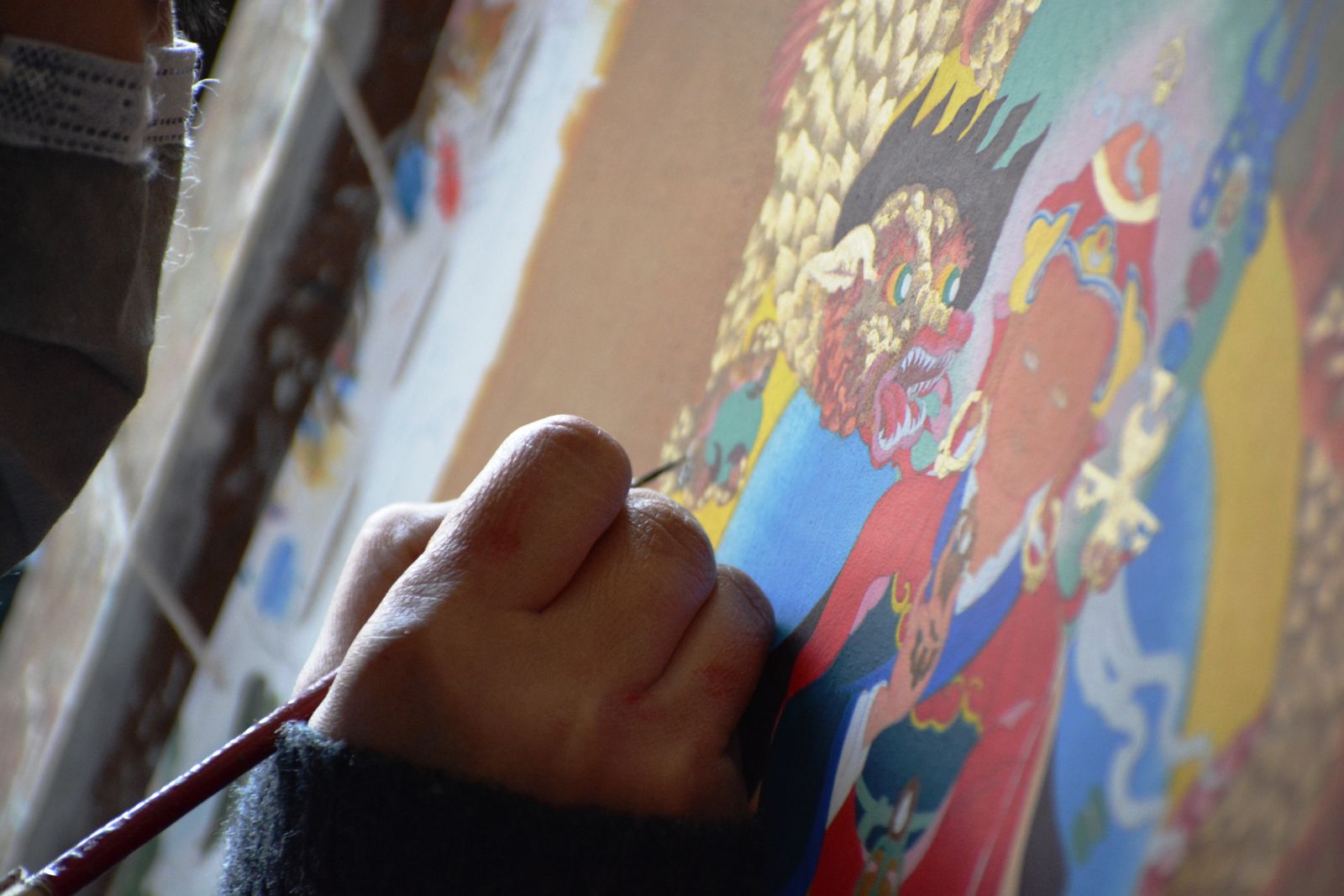
    A painter's hand with a fine brush detailing a wrathful deity on a thangka in Sikkim

    Leave at 07:15 in the Sikkim-registered car that takes over today, because state rules keep sightseeing for local taxis. Rumtek is about an hour across the valley; carry photo ID for the security post at the gate. It is the seat the 16th Karmapa built after he left Tibet in 1959: remember his name, because you meet it again at Tashichho Dzong on day six. At 08:00 the courtyard is still quiet. Back in town by 11:00 for the Namgyal Institute of Tibetology, opened in 1958, whose manuscripts and thangkas are the best primer for everything ahead. Lunch at the Nor-Khill. At 14:30, except on Sundays, the Directorate of Handicrafts and Handloom, set up in 1957 while Sikkim was still a kingdom, where trainees carve choktse tables and paint thangkas. At 17:00 your guide walks you to the gate of Tsuklakhang, the royal chapel where the Chogyals were crowned.

    The momentStanding at the gate of Tsuklakhang at dusk, where Sikkim crowned its Chogyals, two days before you leave their kingdom for Bhutan's.

    InsiderTsuklakhang opens its courtyard for festivals, above all the Kagyed masked dances in December. Tell us your dates and we check whether they fall in your Gangtok nights.

    If the weather turnsIf rain closes the Rumtek road, we switch to Enchey Monastery above town, founded in 1909, and fit Rumtek into the spare hour on tomorrow's return.

    Meals
    Breakfast, Lunch, Dinner
  3. Day 3 · Gangtok

    Tsomgo at 3,753 m, and the pass for Indian passports

    • 110 km, about 5 h
    • High point 4,310 m
    • Sleep at 1,650 m
    • Moderate
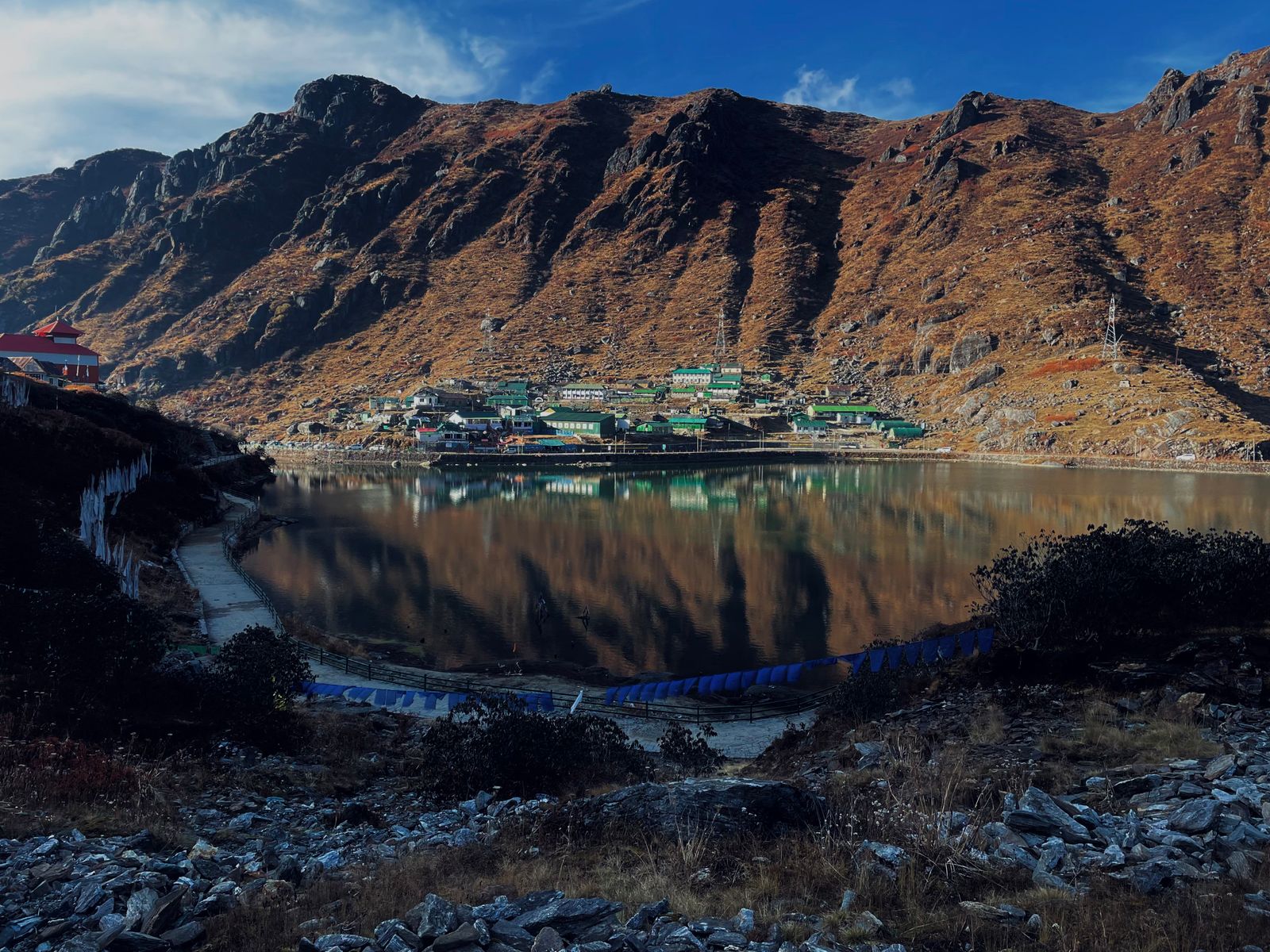
    Tsomgo Lake still as glass under bare brown slopes, the green roofed lakeside settlement reflected in the water

    The Tsomgo permit went in yesterday through our registered Sikkim operator, with photo ID for every guest; it covers children over five, and the rules are set out on /plan/permits-and-visas/. At 19:00 last night we confirmed the road was open. Leave at 07:00 in a warm layer, with water, snacks and an oxygen canister in the boot, and keep the stop at the lake, 3,753 m, short. Indian passport holders then go on to Nathu La at 4,310 m, on the days the Army opens it and never on a Monday or Tuesday; foreign passports top out at Tsomgo. At the pass, look down the far side. That is the Chumbi valley, the wedge of Tibet that lies between Sikkim and Bhutan, and one reason your road to Bhutan the day after tomorrow runs round through Bengal. Foreign guests are back for a late lunch and the spa. Everyone is in Gangtok by 15:00.

    The momentOn the Tsomgo shore at 3,753 m, cold and still, and for Indian passports the pass above it, looking down into Tibet's Chumbi valley.

    InsiderOnly 200 Nathu La permits are issued a day, and in October and November they run out. If an Indian passport holder in your party wants the pass, tell us when you book.

    If the weather turnsIf snow closes the road above the lake, we stop at Tsomgo. If it closes below, we go to Hanuman Tok and Ganesh Tok for the view back to Kanchenjunga.

    Meals
    Breakfast, Lunch, Dinner
  4. Day 4 · Gangtok Phuentsholing

    The long road down to the Bhutan gate

    • 230 km, about 7 h
    • High point 1,650 m
    • Sleep at 293 m
    • Easy
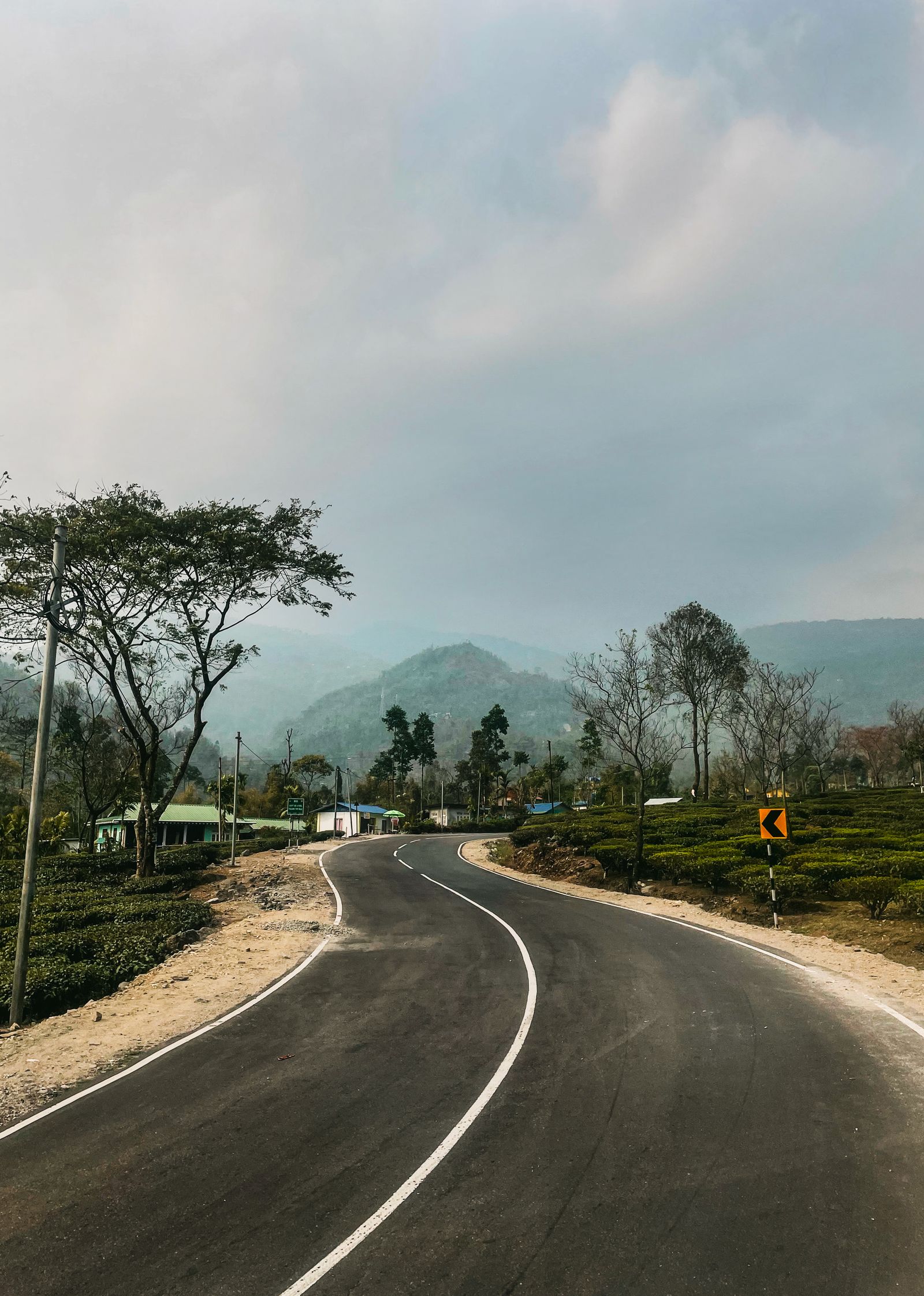
    A new road curving through tea estates near Siliguri, clipped tea bushes on both verges and the first hills rising in haze

    The only long day of the journey: about seven hours at the wheel, with stops, and we would rather you knew now. Leave at 07:00 with breakfast boxes from the Nor-Khill kitchen; your driver has already called the NH10 police post. The road drops to the Teesta and leaves Sikkim at Rangpo. The first stop, at about 09:30, is Teesta Bazaar, on the river bank where the Kalimpong road turns uphill. The ridge above holds Bhutan House, the family home that carries this journey's second royal thread; you meet it again at Tashichho Dzong on day six, and From the Hills into Bhutan tells the house in full. Below Sevoke the hills end, and the road turns east into the Dooars tea country, with a second stop for tea and a stretch at about 11:30. At about 14:00 you reach Jaigaon and walk through the Bhutan Gate, where your Bhutanese guide, registered two days ahead, meets you and a Bhutanese car takes the bags. Late lunch at Hotel Druk, about 100 m inside the gate, and then nothing at all is asked of you. The hour by hour of this day is set out on /plan/on-the-road/#a-day-with-us.

    The momentAt Teesta Bazaar, looking up at the Kalimpong ridge where a princess of Sikkim married into Bhutan's Dorji family.

    InsiderOver 65, or simply prefer shorter days? Choose the Dooars night in Make it more, and reach Phuentsholing by lunch the next day.

    If the weather turnsIf NH10 is blocked near Sevoke, we come down by Gorubathan instead. Papers that run late are finished at 09:00 tomorrow; your room at the Druk is inside the gate either way.

    Meals
    Breakfast, Lunch, Dinner
  5. Day 5 · Phuentsholing Thimphu

    From 293 metres to the capital

    • 144 km, about 5.5 h
    • High point 2,320 m
    • Sleep at 2,320 m
    • Easy
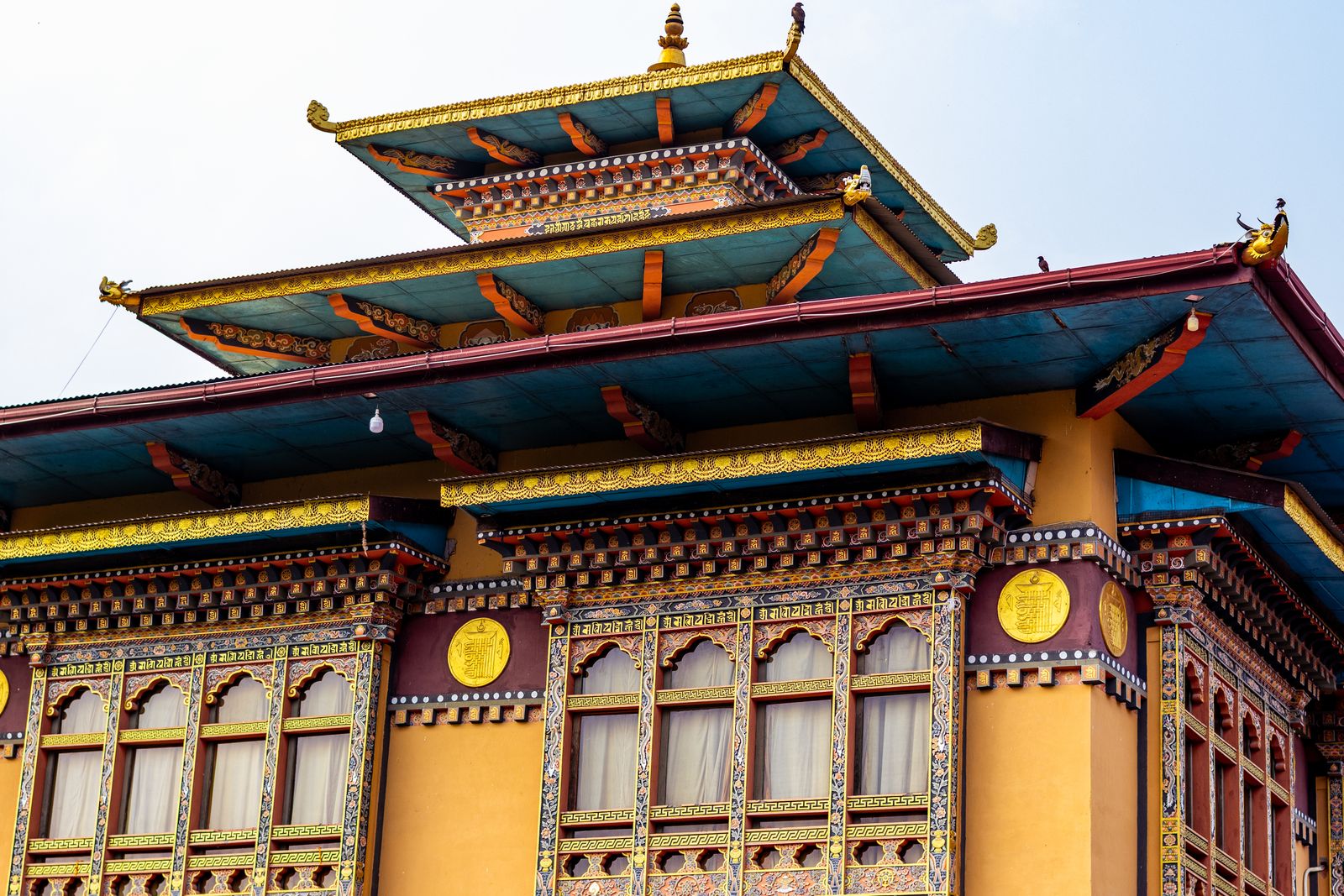
    Tiered gilded roofs and painted wooden window bays of a Buddhist temple in Phuentsholing, the Bhutan border town

    At 07:00, before breakfast, your guide drives you up to Kharbandi Goemba on the slope above town. The plains of Bengal lie flat and hazy below: the last low ground you will see for a week. Leave at 08:00. Within the hour the road has climbed out of the heat into wet forest, and papers are checked at Rinchending and again further up. At Gedu, near 2,000 m, the windows come up. The road drops into the Wang Chhu gorge at Chukha, where a dam built with Indian help in the 1980s sends power south to India. At Chuzom, where the Paro Chhu meets the Wang Chhu, you eat the lunch Hotel Druk packed at dawn, on a bench above the water. Thimphu by about 14:30. Pemako's rooms have hand-painted walls in the Bhutanese manner; take the afternoon slowly, because you have climbed 2,000 m since breakfast.

    The momentThe plains of Bengal from Kharbandi's terrace at 07:00, flat and hazy under the morning, the last low ground for a week.

    InsiderCarry a layer in the car, not the boot: you leave 293 m in shirtsleeves and reach 2,320 m by mid-afternoon.

    If the weather turnsIf a slip closes the road, we wait with tea at Gedu or go back down to the Druk, and never drive past a closure the police have not opened.

    Meals
    Breakfast, Lunch, Dinner
  6. Day 6 · Thimphu

    The Karmapa's dzong and the princess's flag

    • 25 km, about 1 h
    • High point 2,320 m
    • Sleep at 2,320 m
    • Easy
    Tashichho Dzong in Thimphu seen across ripening paddy fields, cloud hanging low over the forested ridges behind

    Your permit from Phuentsholing already covers Punakha and Paro: your guide keeps the copies, and you keep your passports. At 09:00 the car climbs to the Buddha Dordenma, the gilded bronze Buddha finished in 2015 above the southern approach, with some 125,000 smaller Buddhas inside it. At 10:30, on a weekday, the Institute for Zorig Chusum, where students train in the thirteen traditional arts; on a Saturday or Sunday, the archery ground at Changlimithang instead, if a match is on. Lunch in town, then a free hour. From about 17:00, once the government offices close, Tashichho Dzong takes visitors; at a weekend it is open through the day. The third king rebuilt it as the seat of government, and among the lamas who consecrated it in 1968 was the 16th Karmapa, whose seat at Rumtek you saw on day two. Above the courtyards flies the flag. Its first version was made in 1947, for the Asian conference in Delhi, by Mayum Choying Wangmo Dorji, a Gangtok-born daughter of Sikkim's ninth Chogyal, married since 1918 into the Dorji family of Bhutan House: two kingdoms in one piece of silk.

    The momentLooking up at Bhutan's flag over Tashichho Dzong, knowing it was first drawn by a princess of Sikkim's royal house.

    InsiderTashichho is a working seat of government. Collared shirts, long sleeves and covered knees are expected at the gate, so we keep a light jacket for each of you in the car.

    If the weather turnsIn heavy rain we swap the Buddha Dordenma hill for the Folk Heritage Museum, and keep the dzong at 17:00.

    Meals
    Breakfast, Lunch, Dinner
  7. Day 7 · Thimphu Punakha

    Over Dochu La to the rice valley

    • 72 km, about 3 h
    • High point 3,100 m
    • Sleep at 1,200 m
    • Easy
    The great bodhi tree in the rain washed flagstone courtyard of Punakha Dzong, carved wooden galleries on three sides

    Leave at 07:30, while the northern sky is most often clear, for tea at Dochu La's 108 chortens, 3,100 m; then 49 km of hairpins drop you about 1,900 m into orange trees, banana plants and rice. Lunch at a farmhouse near Lobesa at 11:30. At 14:30 you cross into Punakha Dzong, built in 1637 and 1638 where the Pho Chhu meets the Mo Chhu. In this courtyard, on 17 December 1907, Ugyen Wangchuck was enthroned as Bhutan's first king, and the British government was represented by John Claude White, its political officer in Sikkim, who photographed the day: a thread back to the kingdom you left three days ago. The present king married here in 2011. Dhensa by 17:00, cottages in the pines above the river.

    The momentStanding in the courtyard where Bhutan crowned its first king in 1907, three days after you left the Chogyal's guest house.

    InsiderBefore you walk in, look up John Claude White's 1907 photographs of the coronation on your phone. Then find where he stood.

    If the weather turnsWhen cloud hides the northern peaks from Dochu La, we drive straight down to Punakha and try the pass again on the way back to Paro, when the morning sky may be kinder.

    Meals
    Breakfast, Lunch, Dinner
  8. Day 8 · Punakha

    A hilltop chorten and the harvest terraces

    • 35 km, about 1.5 h
    • High point 1,500 m
    • Sleep at 1,200 m
    • Moderate
    Punakha valley from above, rice terraces on the slopes where the Mo Chhu and Pho Chhu meet below Punakha Dzong

    Breakfast at 07:30 on the balcony, the river below in mist. At 08:30 the car follows the Mo Chhu north to the footbridge at Yepaisa, and a 30-minute path through rice terraces climbs to Khamsum Yulley Namgyal Chorten. The queen who raised it in 2004, Ashi Tshering Yangdon, was born in 1959 at Nobgang, in the hills above this valley, one of four sisters who all married the fourth king: Bhutan's royal present has its roots here. Floor above floor of painted deities leads to a roof over the whole valley. Down by 11:00 for a picnic on the riverbank, laid by the Dhensa kitchen. At 14:30 the car climbs to the Sangchhen Dorji Lhuendrup nunnery on its ridge, where young nuns study and the view runs down two valleys. In October and November the rice is cut and threshed by hand in the fields below; Dhensa lists rice threshing among its experiences, and we ask for it this afternoon. Dinner at the resort, with red rice from the valley you walked through.

    The momentIn harvest season, beating rice sheaves on a mat beside a Punakha family, grain flying and everyone laughing at your aim.

    InsiderRafting is easy to add on the Mo Chhu's gentler stretch. Tell us by the evening of day seven and we book the boat and crew for this afternoon.

    If the weather turnsIf rain soaks the terrace path, we go to the nunnery first and keep the chorten walk for tomorrow's first hour, before the drive to Paro.

    Meals
    Breakfast, Lunch, Dinner
  9. Day 9 · Punakha Paro

    Back over the pass, by a saint's chain bridge

    • 126 km, about 4.5 h
    • High point 3,100 m
    • Sleep at 2,200 m
    • Easy
    Iron chain bridge hung with prayer flags over the Paro Chhu below Tamchog Lhakhang, the temple on its dry hillside above

    Leave Dhensa at 08:00 and cross Dochu La once more. Just short of Thimphu, stop at Simtokha Dzong, which the Zhabdrung raised in 1629 and which still stands in its first form, the oldest dzong to do so. Its school of language and Buddhist learning opened in 1961 at the suggestion of Mayum Choying Wangmo Dorji, the same Sikkimese princess who made the flag. Lunch in Thimphu, then the Paro road. About 5 km past Chuzom, pull over below Tamchog Lhakhang, founded by Thangtong Gyalpo, the 15th-century saint who forged iron-chain bridges across Tibet and Bhutan. Walk down and cross the chain bridge over the Paro Chhu to his temple, which his descendants still keep. Paro by about 16:30, and Zhiwaling for three nights, stone and timber with a temple in the grounds. Dinner there, and an early night: Taktsang is two mornings away.

    The momentStepping onto Thangtong Gyalpo's bridge above the Paro Chhu, iron links cold under your hand and the river loud beneath.

    InsiderThe path down to the Tamchog bridge is short but steep and loose. Wear shoes with grip, not sandals, and let the guide carry your bag.

    If the weather turnsIf the river is high or the bridge is closed for repair, we see Tamchog from the road and give the hour to a slower lunch in Thimphu.

    Meals
    Breakfast, Lunch, Dinner
  10. Day 10 · Paro

    Paro's dzong, a farm kitchen, the victory fort

    • 40 km, about 1.5 h
    • High point 2,580 m
    • Sleep at 2,200 m
    • Easy
    Drukgyel Dzong on its rocky spur above village houses at the head of the Paro valley, snow peaks rising behind

    A gentle day, so your legs are rested for tomorrow. At 09:00 Rinpung Dzong, consecrated in 1646, whose courtyards the district's monks still share with its offices. Walk down through Paro's main street, its shopfronts painted in the Bhutanese manner, for coffee. At 12:00, lunch in a farmhouse kitchen: ema datshi at the heat you asked for, with red rice and suja, the salted butter tea. At 14:30 the car goes 15 km up the valley to Drukgyel Dzong, built in 1649 to mark a victory over an army from Tibet, burned in the early 1950s and chosen for rebuilding in 2016. The old trade path from Tibet came down this valley. On a clear afternoon Jomolhari shows white at its head. At 18:00 your guide briefs you on tomorrow: boots, layers, water, poles, and whether to book a pony, which the rules require a day ahead.

    The momentJomolhari showing white above Drukgyel Dzong at the head of the valley, where Tibet's armies once came down.

    InsiderAnyone who wants no chilli at all gets kewa datshi, potatoes melted into cheese, from the same stove. Tell your guide at breakfast.

    If the weather turnsIf rain sets in, we keep the dzong and the farmhouse, skip Drukgyel, and give the afternoon to Zhiwaling's heated indoor pool and its temple.

    Meals
    Breakfast, Lunch, Dinner
  11. Day 11 · Paro

    Taktsang, then a bath of fire-heated stones

    • 30 km, about 1 h
    • High point 3,120 m
    • Sleep at 2,200 m
    • Active
    Taktsang monastery clinging to its granite cliff above Paro, gilded roofs over whitewashed walls and pines below

    Your last climb, on legs that have had ten days in the hills. Breakfast at 06:15 and on the trail by 07:15, ahead of most walkers; a pony, if you booked one yesterday, carries you as far as the cafeteria, and from there everyone walks. The climb's numbers and rules live on one card at /destinations/bhutan/#taktsang. Inside, your guide tells the story of Guru Rinpoche and his tigress, the last of the teachers whose stories this journey has followed, after the Karmapa at Rumtek and Thangtong Gyalpo at his chain bridge. Back down by 13:30, lunch late, and Zhiwaling by 15:00. The spa put the river stones in the fire this afternoon; at 17:00 they go, hissing, into a wooden tub with khempa leaves, and the climb leaves your legs. Farewell dinner at 19:30.

    The momentReaching the gate at 3,120 m, the Paro valley far below, the whole climb behind you and the cave shrine ahead.

    InsiderThe descent tires knees more than the climb tires lungs. We carry poles in the car; most guests ignore them going up and are glad of them coming down.

    If the weather turnsIf heavy rain is forecast, we swap days ten and eleven the evening before. On the day, the cafeteria faces the monastery across the gorge.

    Meals
    Breakfast, Lunch, Dinner
  12. Day 12 · Paro Paro airport (PBH)

    Paro airport, and home

    • 10 km, about 0.5 h
    • High point 2,235 m
    • Easy
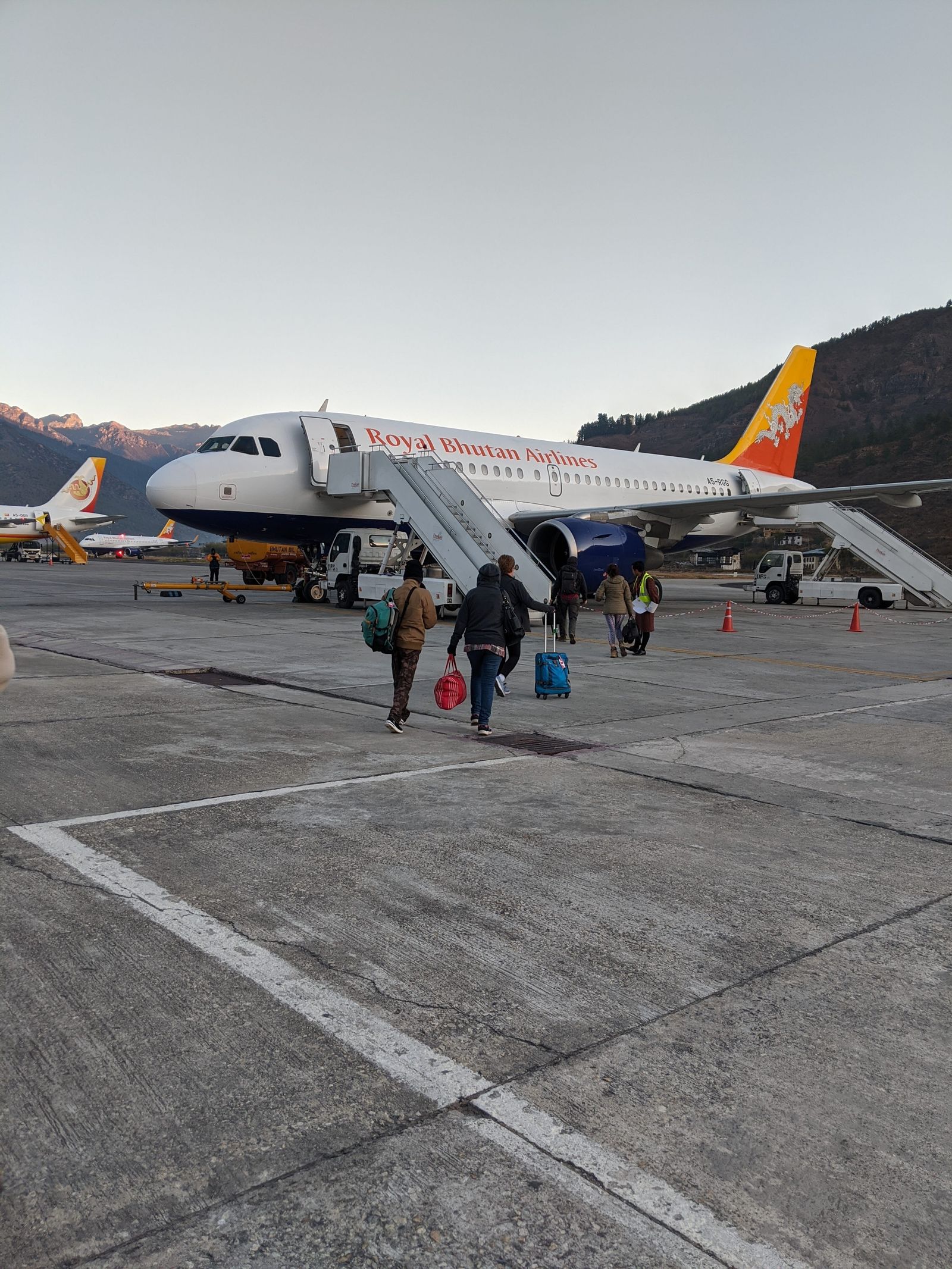
    Travellers with bags crossing the Paro airport apron to board a Drukair Airbus, dry pine hills behind

    Breakfast at 06:45; the bags go to the car at 07:30, and the airport is about 20 minutes away. In Drukair's October 2026 timetable the Delhi flight leaves at 09:40 every day, while Kolkata and Bagdogra have their own days of the week; we choose the one that meets your connection home. Last night your guide confirmed the seats and printed every permit and ticket, so check-in is a formality. If you have ngultrum left, spend it or leave it as a tip: it is pegged to the rupee, and your guide can change it back. At the terminal door you say kadrinchey la, thank you, to the two people who drove and walked the kingdom with you. From the moment you landed in Bagdogra, our team in the Darjeeling hills has kept one number open for you, and it stays open until your flight is down.

    The momentA last kadrinchey la at the terminal door to the guide and driver who carried you across a kingdom.

    InsiderIf your onward flight leaves Delhi or Kolkata the same evening, let us book a day room there. Paro waits on weather, and a missed connection costs far more.

    If the weather turnsCloud can keep Paro's morning flights on the ground. If it does, your guide rebooks the next seat and takes you back to Zhiwaling, and we rearrange your onward flight from Delhi or Kolkata.

    Tonight
    Homeward
    Meals
    Breakfast

Where you will stay

Where you sleep, five houses

The Elgin Nor-Khill, Gangtok, Hotel Druk, Phuentsholing, Pemako Thimphu, Dhensa Resort, Punakha and Zhiwaling Heritage. Prefer a different house on any night? Say which and we re-price it.

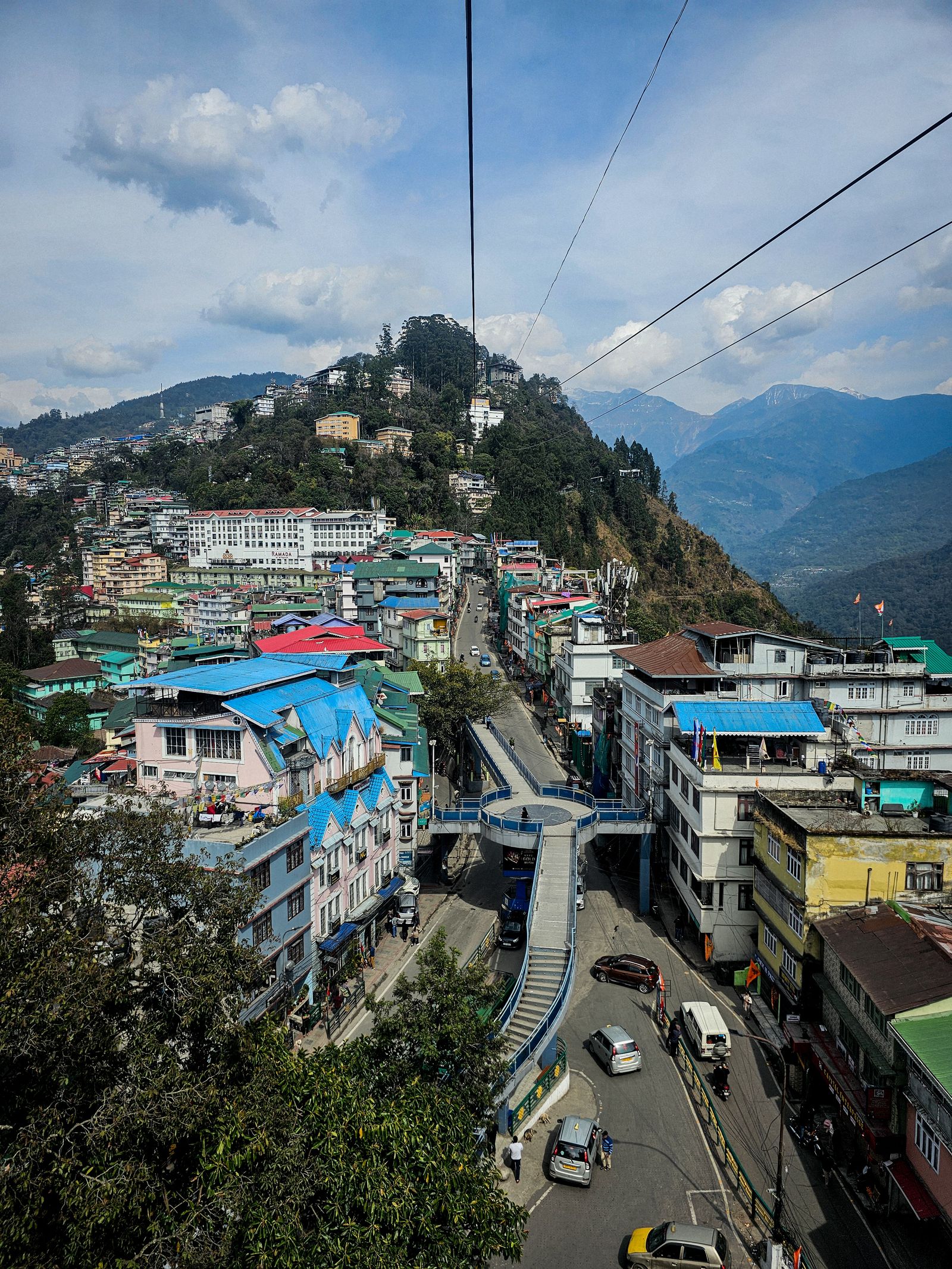
  1. Gangtok seen from above, coloured buildings stacked down the ridge with a footbridge over the road and hills beyond
    Gangtok from above, the town the Nor-Khill sits in the middle of.Ahad Hasan / Pexels
    3 nights

    The Elgin Nor-Khill, Gangtok

    Gangtok

    Built as the Chogyal's guest house for visiting dignitaries, around a garden he loved: Sikkim's royal past, in the middle of town.

    Ask for A Deluxe Double over the Kanchen garden, or a Premium Suite with its own sitting room

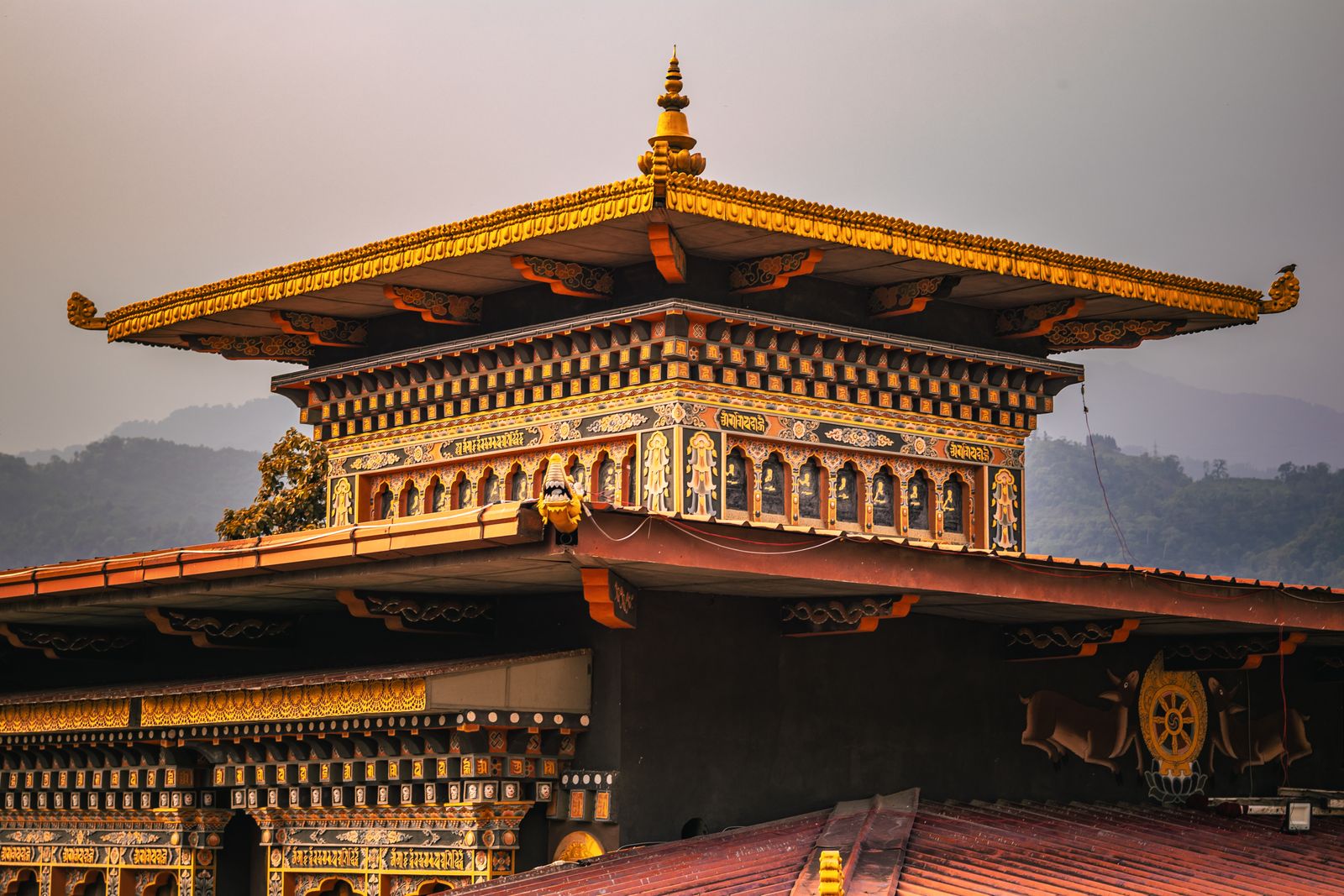
  2. The gilded roof and painted eaves of a Bhutanese temple in the border town of Phuentsholing
    A Bhutanese temple roof in Phuentsholing, the border town where the hotel stands.Soham Kundu / Pexels
    1 night

    Hotel Druk, Phuentsholing

    Phuentsholing

    Steps from the gate and the immigration office, so papers take minutes, not a morning. Plain, clean and well run.

    Ask for The quietest room they can give, away from the street

  3. The ochre and timber front of the hotel in Thimphu built as the Taj Tashi, now Pemako Thimphu
    The house itself in central Thimphu, photographed while it still traded as the Taj Tashi.Christopher J. Fynn, CC BY-SA 4.0, via Wikimedia Commons
    2 nights

    Pemako Thimphu

    Thimphu

    The capital's grand hotel, the former Taj Tashi, now Bhutanese owned: hand-painted rooms, central, a walk from Norzin Lam.

    Ask for A Deluxe Room as priced, or the Deluxe with Private Sit Out, 600 sq ft, at a supplement

  4. A braided river, rice terraces and forested ridges in the Punakha valley of Bhutan
    The Punakha valley from above the river, the terraces the pine cottages look over.Anil Sharma / Pexels
    2 nights

    Dhensa Resort, Punakha

    Punakha

    24 rooms in six cottages among pines above the river, looking over the rice terraces, with home-style Bhutanese cooking and a spa.

    Ask for A cottage room with a balcony facing the river and the paddy

  5. The stone and timber front of Zhiwa Ling hotel in the Paro valley of Bhutan lit at dusk
    Zhiwaling at dusk, the stone walls and painted timber galleries of the Paro valley house.Xiaojun Deng, CC BY 2.0, via Wikimedia Commons
    3 nights

    Zhiwaling Heritage

    Paro

    A heritage house in the Paro valley with a temple in the grounds and a meditation house that looks at Taktsang, and river stones heated for your bath after the climb.

    Ask for Junior Suite, with a valley view requested at booking

Price and what it covers

from₹5,30,000

per person, twin share, on Indian passports, with Sikkim's permits and a one-way flight home from Paro included. How our prices are built

About £4,130 or US$5,520 at the rates of 19 September 2026.

On other passports, about ₹6,01,000 (£4,690, US$6,260). Bhutan's Sustainable Development Fee is US$100 a night for most visitors, against ₹1,200 for Indian passports, for 8 nights here, plus a US$40 visa. How the fee works

Included

  • Innova Crysta and driver from the hills for the two long drives: Bagdogra to Gangtok, and Gangtok to the Phuentsholing gate
  • A Sikkim-registered car and driver for the Gangtok days and the Tsomgo road, as state taxi rules require
  • In Bhutan, a Land Cruiser Prado or similar with a Bhutanese driver, from the gate to Paro airport
  • A licensed Bhutanese guide for your eight nights in Bhutan, whose name is lodged at the Phuentsholing land port 48 hours before you cross
  • A Gangtok guide for Rumtek, the Namgyal Institute of Tibetology and Tsomgo
  • For foreign guests, Sikkim's Restricted Area Permit filed on e-FRRO about 30 days ahead; for everyone, the Tsomgo and Nathu La permits and Sikkim's ₹50 tourist fee
  • Your Bhutan entry permit or e-visa, and eight nights of Bhutan's fee at the Indian rate, ₹9,600 a guest (see /plan/what-it-costs/#bhutan-sdf)
  • Eleven nights across five houses, two guests to a room, with every meal from the first dinner in Gangtok to the last breakfast in Paro
  • Monument fees in both countries, including Taktsang, Punakha Dzong and Tashichho Dzong
  • Farmhouse lunch in Paro and a hot stone bath at Zhiwaling after Taktsang
  • Your flight home: one-way economy from Paro to Delhi, Kolkata or Bagdogra
  • One number in the Darjeeling hills, answered 24x7 from Bagdogra to Paro

Not included

  • Flights to Bagdogra
  • Travel insurance, which Bhutan requires of Indian visitors and we advise for everyone
  • Other passports pay Bhutan US$100 a night rather than ₹1,200, plus a US$40 visa
  • Tips for guides and drivers
  • Drinks other than tea, coffee and water, and laundry
  • Pony hire on the Taktsang trail, booked on request
  • Rafting and the other optional add-ons below

Make it more Arranged on request, priced in your quote

  • Amankora for the Bhutan nightsSwap Thimphu, Punakha and Paro for Amankora's lodges, including the eight-suite Punakha farmhouse above the paddies.
  • Rafting on the Mo ChhuA guided float on a gentle stretch of the river below Punakha Dzong, with a picnic on the bank. Drier months only.
  • Helicopter from Bagdogra to GangtokWhen the state service flies, a short hop to Burtuk heliport instead of 4.5 hours by road; hand luggage only, cases by car.
  • A night in the DooarsSplit the Gangtok to Phuentsholing road with a night in the tea country, turning seven hours into two easy halves.

Before you go

Before you go on this route

Choose another journey ifIf a seven-hour road day or a 520 m climb sounds like work, choose Bhutan: The Western Valleys, which flies you into Paro and keeps every drive short.

  1. Sikkim: foreign and OCI guests need the Restricted Area Permit, filed online through e-FRRO about 30 days before reaching the state; Tsomgo permits cover children over five, and Nathu La is for Indian citizens only. The rules are on /plan/permits-and-visas/.
  2. Bhutan: Indian guests carry an original passport or voter ID. Other passports need a US$40 e-visa, and an Indian visa that lets you back in by air at Delhi, Kolkata or Bagdogra, since you fly home from Paro.
  3. Day four is timed for a weekday, because the immigration office at the Bhutan gate keeps Monday to Friday hours.
  4. Altitude: every bed is at or below 2,320 m. The high points are day visits: Tsomgo, 3,753 m, and for Indian passports Nathu La, 4,310 m, on day three, then Taktsang, 3,120 m, on day eleven. Our altitude rules: /plan/before-you-travel/#altitude-rules.
  5. Pack layers: Gangtok nights run from about 14 °C in October to 7 °C in December, Thimphu's to near freezing in December. Dzongs want long sleeves and covered knees.
  6. Money: the ngultrum trades at par with the rupee, and rupees in small notes are accepted widely in Bhutan. Carry small notes for the monasteries of both kingdoms; cards work in the larger hotels, rarely in villages.
  7. Bhutan runs 30 minutes ahead of India, and Indian SIMs roam patchily there. Your guide helps you buy a local SIM in Phuentsholing, and our 24x7 number works on WhatsApp over hotel wifi.
  8. For a tipping figure to go by, see /plan/before-you-travel/#tipping; nothing about tips is compulsory.

Questions

Six questions about Two Kingdoms: Sikkim to Bhutan by Road

Ask on WhatsApp
Can you travel from Sikkim to Bhutan by road?

Yes, though not directly. The two kingdoms share no border: to the north the Chumbi valley, a wedge of Tibet, lies between them, so every road runs down NH10 to the Teesta and east through the Dooars in West Bengal to Phuentsholing. From Gangtok that is about 230 km and seven hours with stops. We make it one long day, sleep at the gate, and climb to Thimphu the next morning.

How many nights do Sikkim and Bhutan need together?

Ten nights at the least, and eleven as Two Kingdoms runs it: fewer means skipping Punakha or driving on the days you should be walking. Three nights in Gangtok give you Rumtek, the town and a safe day at Tsomgo; one at Phuentsholing breaks the road; then two in Thimphu, two in Punakha and three in Paro, with Taktsang near the end.

Why start in Sikkim instead of flying straight to Paro?

Because the two kingdoms explain each other. The Karmapa whose seat you see at Rumtek helped consecrate Tashichho Dzong in 1968; the Gangtok-born princess who drew Bhutan's first flag married into Bhutan House; and Britain's political officer in Sikkim represented his government at Bhutan's first coronation in Punakha Dzong in 1907. Sikkim also adds Tsomgo Lake at 3,753 m, and the road gives you the Dooars.

Two Kingdoms or Bhutan: The Western Valleys?

Choose The Western Valleys if a seven-hour road day sounds like work: it flies you into Paro, keeps every drive short and gives Bhutan six nights. Choose Two Kingdoms for the story between the kingdoms: Rumtek and Tsomgo in Sikkim, the road through the Dooars, the princess's flag at Tashichho and the coronation courtyard at Punakha, eleven nights in all.

Is the seven-hour road day too much for us?

For most travellers it is long rather than hard: two stops, breakfast boxes from the Nor-Khill and a late lunch just inside the Bhutan gate by about 14:00. If you are over 65, or simply prefer shorter days, choose the Dooars night in Make it more. It splits the road into two easy halves, adds one night, and brings you to Phuentsholing by lunch the next day.

Can we do Two Kingdoms in December?

Yes, with trade-offs. December brings some of the clearest light of the year, and Gangtok's Kagyed masked dances fall in that month; tell us your dates and we check whether they meet your Gangtok nights. But Thimphu's nights fall to near freezing, the Tsomgo road is at its coldest, and snow can close the way on to Nathu La, so Indian passport holders may have to stop at the lake.

Sources we checked for this itinerary (48)
  1. Elgin Nor-Khill room rates checked for 2025-26 (Deluxe Double, all meals); 25 rooms and suites
  2. Nor-Khill built as the Chogyal's royal guest house for visiting dignitaries
  3. Only Sikkim-registered taxis may do sightseeing, Tsomgo and Nathu La inside Sikkim; West Bengal taxis drop and pick up
  4. Taxi fares for Bagdogra to Gangtok and the Tsomgo and Nathu La day, checked for 2025-26
  5. Gangtok to Phuentsholing by taxi: about 220 km and 7 to 7.5 hours; fare checked for 2025-26
  6. Rumtek: 16th Karmapa arrived 1959, relics from Tsurphu, new seat inaugurated on Losar 1966
  7. Namgyal Institute of Tibetology opened 1 October 1958
  8. Enchey Monastery established 1909, Nyingma
  9. Nathu La 4,310 m on the old trade route between Sikkim and Tibet; Indian citizens only, permits in advance
  10. Nor-Khill built in 1932 by the Chogyal as the royal guest house for heads of state and dignitaries; acquired by B.R. Oberoi in 1975; the Chogyal painted in the Kanchen garden
  11. Tsuklakhang, royal chapel of the Chogyals, used for coronations; Pang Lhabsol in September and Kagyed in December
  12. Directorate of Handicrafts and Handloom set up 1957 at Zero Point; choktse and thangka training; 10:00 to 16:00, closed Sundays
  13. Mayum Choying Wangmo Dorji, born 1897 in Gangtok, daughter of Chogyal Thutob Namgyal; married Sonam Topgay Dorji at Bhutan House, Kalimpong, on 5 April 1918; designed Bhutan's first flag for the Asian conference in New Delhi, March 1947
  14. Pemako Thimphu 2026 room rates checked (Deluxe Room, half board)
  15. Dhensa Resort room rates checked for 2026 (with breakfast, tax extra); 24 rooms in six cottages
  16. Kaja Throm, the renewed Centenary Farmers Market in Thimphu, inaugurated 18 September 2023
  17. Indian e-Tourist visas (30-day, 1-year, 5-year) allow multiple entries
  18. Tsomgo 836 m long; Nathu La 4,310 m and Indian citizens only
  19. Indian visitors: passport or voter ID, SDF INR 1,200, half for 6 to 12, guide and DoT-certified hotels and travel insurance required (page updated 17 September 2026)
  20. Phuentsholing immigration office 9 AM to 5 PM with a 1 to 2 PM lunch break, closed weekends; online permits take 4 to 5 working days
  21. Guides must be registered 48 hours before tourists enter at the Phuentsholing land port; SDF US$100 for most foreign tourists
  22. Hotel Druk Phuentsholing is close to the permit office; reviews updated 2026
  23. Pemako Thimphu is the former Taj Tashi, 66 rooms, Bhutanese owned since 2023
  24. Pemako Thimphu Deluxe Room with Private Sit Out, 600 sq ft, hand-painted walls
  25. Dhensa Resort: 24 rooms in six cottages above the Punakha river, Kibu Spa, rice threshing experiences
  26. Zhiwaling Heritage 2026 rates checked: Junior Suite, its lowest category, with breakfast, dinner, GST and service; peak and regular seasons; heated indoor pool
  27. Tashichho Dzong rebuilt by the third king, completed 1968, consecrated by the Je Khenpo, the 16th Karmapa and Je Kudre
  28. Simtokha Dzong built 1628 to 1629 by the Zhabdrung, oldest dzong surviving in its original form; school of linguistics founded there in 1961 at the suggestion of Mayum Choying Wangmo Dorji
  29. Buddha Dordenma completed 25 September 2015 above the southern approach to Thimphu, with 125,000 smaller gilded bronze Buddhas
  30. Punakha Dzong 1637 to 1638 at the Pho Chhu and Mo Chhu; Ugyen Wangchuck crowned there in 1907; royal wedding 13 October 2011; jacarandas
  31. Khamsum Yulley Namgyal Chorten built 2004 by the Queen Mother, about 30 minutes uphill from the footbridge at Yepaisa
  32. Tamchog Lhakhang founded by Thangtong Gyalpo, about 5 km from Chuzom on the Paro road, maintained by his descendants; iron chain bridges
  33. Drukgyel Dzong built 1649 after victory over a Tibetan invasion, burned in the early 1950s, rebuilding announced 2016
  34. Rinpung Dzong consecrated 1646
  35. Taktsang open 08:00 to 17:00 with a daily 13:00 to 14:00 closure; temple built 1692 around Guru Rinpoche's cave; phones, cameras and bags into lockers at the last gate (the same source and wording as the Taktsang facts card on /destinations/bhutan/, checked 20 September 2026)
  36. Drukair October 2026 (editor re-read the PDF): KB200 Paro to Delhi 09:40 daily; Paro to Kolkata Monday and Friday via Gelephu, Wednesday and Saturday direct; Paro to Bagdogra 16:20 Monday and Friday
  37. Monument fees before the September 2026 revision (January 2026 list), used in the price basis
  38. Ngultrum pegged at par to the Indian rupee
  39. Monument fees for foreign visitors revised from September 2026: Taktsang Nu 2,000, main dzongs Nu 1,000; under-18s half
  40. The Chumbi Valley projects south from the Tibetan plateau, intervening between Sikkim and Bhutan; Nathu La and Jelep La lead into it from Sikkim
  41. Ugyen Wangchuck enthroned as first hereditary king in Punakha Dzong on 17 December 1907; the British political officer John Claude White represented the British government
  42. John Claude White, Political Officer in Sikkim from 1889, photographed the coronation of Bhutan's first king in 1907
  43. Ashi Tshering Yangdon born 21 June 1959 at Nobgang, Punakha; built Khamsum Yulley Namgyal Chorten in 2004
  44. Ashi Dorji Wangmo born at Nobgang, Talog gewog, Punakha; the fourth king married her and three of her sisters
  45. Tourism Rules and Regulations 2024, rule 13: a tourist with a visa or permit may visit any area except restricted and prohibited ones (no separate route permit), as cited by the Bhutanese local reviewer, September 2026
  46. Nathu La open Wednesday to Sunday for Indian citizens, with a daily cap of 200 permits (Gangtok local reviewer, September 2026)
  47. Archery matches at Changlimithang, Thimphu; national sport since 1971
  48. Tashichho Dzong admits visitors only after the government offices close on weekdays, reported as about 17:00 to 18:30, and through the day at weekends; published hours differ, so the copy says 'from about 17:00' (checked 20 September 2026)

Checked September 2026. We confirm permits, fees and flights again for your dates.

Plan my journey

Two Kingdoms: Sikkim to Bhutan by Road, shaped around you

At its best October to December, March to May. Tell us your month and who is travelling, and we reply within 24 hours with this journey priced for your dates.

Length
11 nights
From
₹5,30,000 per person
At its best
October to December, March to May
Bases
Gangtok, Phuentsholing, Thimphu, Punakha, Paro
+91 86178 24110 Message a designer Support 24×7, every day of your journey

AboutTwo Kingdoms: Sikkim to Bhutan by Road, 11 nights

With country code if outside India. Either this or email is enough.
Who is coming, the pace you like, the occasion. A sentence is fine.
Add more detail
Their ages help: add them in your note
Permits in Sikkim and fees in Bhutan depend on it
This journey starts at ₹5,30,000 per person. Your band tells us which rooms to price.
Calls from our office, 8am to 9pm IST (GMT+5:30)
Darjeeling, Kalimpong, Gangtok, Pelling, Bhutan, Nepal

No deposit to begin, and nothing is booked until you say yes.